
Diaspora
UK’s New Government Moves To Oust 92 Unelected Peers From Upper House In Bid For Reform

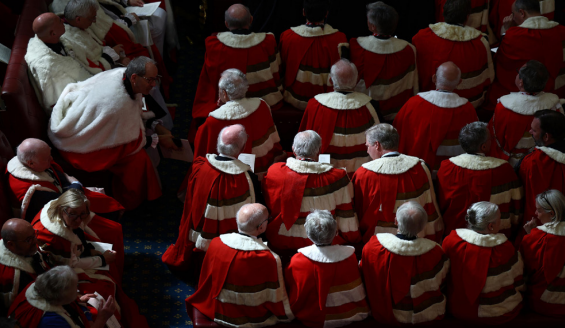
In a significant move towards reforming the UK’s parliamentary system, the new government has announced plans to remove 92 hereditary lawmakers from the House of Lords. This decision is part of a broader effort to modernize the unelected upper chamber, which has long been criticized for being out of touch with the British people.
The House of Lords, which is larger than any similar institution in a democracy, is composed of around 800 lawmakers, most of whom are appointed for life. The average age of members of the House of Lords is 71, leading many to argue that the institution is in need of fresh perspectives and representation that reflects the diversity of the UK population.
The UK’s new government, led by the Labour Party, has pledged to modernize the country’s uncodified constitution. The removal of hereditary peers is seen as a key step in this process. Hereditary peers are members of the aristocracy who have inherited their titles, and critics argue that their presence in the House of Lords is outdated and indefensible.
The move has been welcomed by many who see it as a step towards creating a more democratic and representative upper chamber. However, some have expressed concerns about the potential impact on the country’s traditions and institutions.
The reform of the House of Lords has been a long-standing issue in UK politics, with many arguing that the current system is unsustainable. The new government’s move is seen as a significant step towards creating a more modern and accountable parliamentary system.
The removal of hereditary peers will be a gradual process, with a committee established to oversee the reform. The committee will consider the merits of each hereditary peer and make recommendations on their continued membership in the House of Lords.
The reform of the House of Lords is part of a broader package of constitutional reforms announced by the new government. Other measures include the establishment of a constitutional convention to consider wider reforms to the UK’s political system. The move has been welcomed by many in the UK, who see it as a significant step towards creating a more democratic and accountable parliamentary system. As the UK continues to evolve and change, it is clear that its institutions must also adapt to reflect the needs and values of its people



Zenith Bank Plc has announced a Diaspora engagement programme aimed at providing essential banking and identity services to Nigerians residing in the United States, with activities scheduled to hold in Houston and Dallas, Texas.
The initiative, according to information obtained by Diaspora Watch Newspaper, targeted at Nigerians in the diaspora, is designed to ease access to banking services and strengthen financial inclusion among citizens living abroad.
The programme will feature free Bank Verification Number (BVN) enrolment, National Identification Number (NIN) enrolment, seamless account opening, account reactivation, and digital banking onboarding.
Diaspora Watch Newspaper further gathered that participants will also benefit from mobile and internet banking activation, instant debit card issuance, and access to mortgage products offered at concessionary rates.
The engagement will further provide a platform for interaction with IT experts, creatives, influencers, and other service exporters, in line with efforts to deepen diaspora participation in Nigeria’s economy.
The Houston leg of the exercise will take place at the Hilton Houston Post Oak by the Galleria on February 24, 25 and 28, 2026, while another session will hold at The Ion, 4201 Main Street, Houston, on February 26 and 27, 2026.
The Dallas session is scheduled for March 3, 4 and 5, 2026, at the Sheraton Dallas Hotel by the Galleria.
Activities are expected to run daily from 9:00am to 6:00pm. Prospective participants have been advised to come along with valid proof of address as stipulated in the registration requirements.
Zenith Bank noted that the programme forms part of its ongoing diaspora banking strategy, aimed at supporting Nigerians abroad with convenient access to financial services and fostering stronger economic ties between the diaspora community and Nigeria.
For further enquiries, interested individuals are encouraged to contact Zenith Bank’s Diaspora Banking desk via WhatsApp or telephone, or through the official diaspora banking email.
Register for the event: JOIN ZENITH BANK IN THE UNITED STATES OF AMERICA TEXAS
Website: https://www.zenithbank.com
WhatsApp/call: +234 913 107 2967
Zenith Bank to Host Diaspora Engagement, Banking Services for Nigerians in Texas



Nigeria – US Defence Cooperation: A Reflection from the Diaspora, by Boniface Ihiasota
The defence relationship between Nigeria and the United States represents one of the most complex and consequential aspects of Nigeria’s foreign policy in the 21st century. Rooted in decades of military engagement, training, strategic dialogue, intelligence sharing, and equipment acquisition, this partnership reflects shared interests in regional stability, combating violent extremism, and strengthening military institutions. For many in the Nigerian diaspora, this cooperation carries both hopes for enhanced security at home and concerns about sovereignty, national strategy, and the implications of external influence.
At its core, Nigeria-US defence cooperation has evolved from traditional military diplomacy to a more multi-faceted, operational collaboration. Since the early 2000s, the United States has provided sustained security sector assistance to Nigeria. According to U.S. government data, more than $232 million in security support was delivered between 2000 and 2021, with notifications of $593 million in Foreign Military Sales and approximately $305 million in direct commercial defence sales to support counter-terrorism, border security, and professionalization of the Nigerian Armed Forces. In 2022 the U.S. announced nearly $997 million in a major foreign military sale that included attack helicopters and associated training as part of long-term capability enhancement.
In practical terms, the partnership nurtures capacity building, professional military education, and logistics cooperation. Both nations have exchanged senior military leaders and engaged in joint strategic dialogues to align responses to shared threats. Nigerian defence officials and U.S. counterparts have regularly convened to strengthen frameworks for cooperation, reaffirming commitments to respect Nigeria’s sovereignty while leveraging U.S. technical expertise.
As insecurity in Nigeria has worsened, especially with the prolonged insurgency of Boko Haram and the Islamic State West Africa Province (ISWAP) as well as rising banditry and extremist violence, the practical aspects of the partnership have taken on heightened urgency. Recent developments illustrate this vividly. In early 2026, Nigeria formally invited additional U.S. military support for training, intelligence sharing, and technical assistance. Nigeria’s Defence Headquarters on Monday confirmed the arrival of about 100 U.S. military personnel and equipment at Bauchi, with planned joint training exercises aimed at enhancing Nigerian troops’ capacity to detect and neutralize extremist groups. Local authorities clarified that the U.S. personnel serve in advisory and training roles, under Nigerian command, in line with bilateral agreements and respect for Nigerian sovereignty.
In neighboring Abuja and among diaspora communities, these movements sparked broad discussions about what external military involvement means for Nigeria’s autonomy and long-term security strategy. Advocacy groups like Citizens for Strategic Defence Cooperation have publicly endorsed the expanded partnership while stressing that it does not erode Nigeria’s sovereignty. They describe the engagement as “measured and strategic,” focused on capacity building, intelligence systems, and joint problem-solving rather than occupation or direct combat.
Beyond boots on the ground, the United States has engaged Nigeria in targeted counter-terrorism operations. In late 2025, the U.S. carried out airstrikes against Islamic State-linked camps in northwest Nigeria with Nigerian approval, employing precision guided munitions through U.S. Africa Command (AFRICOM) platforms. These strikes were designed to disrupt militant networks operating from Sahel corridors and were followed by coordinated intelligence sharing.
Still, the defence cooperation is not without controversy. In the diaspora, commentary reflects a spectrum of views: from optimism about the gains in confronting violent extremism to unease about foreign intervention and the framing of Nigeria’s internal conflicts in international discourse. Former U.S. statements by political leaders, including those linking Nigeria’s actions to religious persecution or threatening aid cuts, have sometimes strained diplomatic goodwill, prompting the Nigerian government to clarify its position and reject broad characterizations of the security situation.
Nonetheless, there are tangible operational outcomes that diaspora stakeholders often highlight as evidence of positive cooperation. Enhanced intelligence sharing has contributed to improved situational awareness for Nigerian forces during operations like Operation Hadin Kai in the North East and Operation Fasan Yamma in the northwest. The timely delivery of military hardware — including drones, helicopters, spare parts, and support systems — pledged by the U.S. demonstrates a sustained material investment in Nigeria’s defence architecture.
For many Nigerians abroad, this partnership epitomizes the balancing act between external support and internal agency. On one hand, there is recognition that no nation is an island in confronting transnational threats. On the other, there is a persistent call for transparency, accountability, and strategies that prioritize civilian protection and national ownership of security frameworks.
In conclusion, Nigeria–U.S. defence cooperation is a nuanced, evolving relationship rooted in shared interests and longstanding military engagement. While it brings considerable resources, training, and strategic depth to Nigeria’s fight against violent extremism, it also requires careful navigation of national interests, sovereignty considerations, and public perceptions — both at home and within the vibrant Nigerian diaspora. Ensuring that this cooperation yields tangible security improvements without undermining national autonomy remains a shared challenge for both nations.

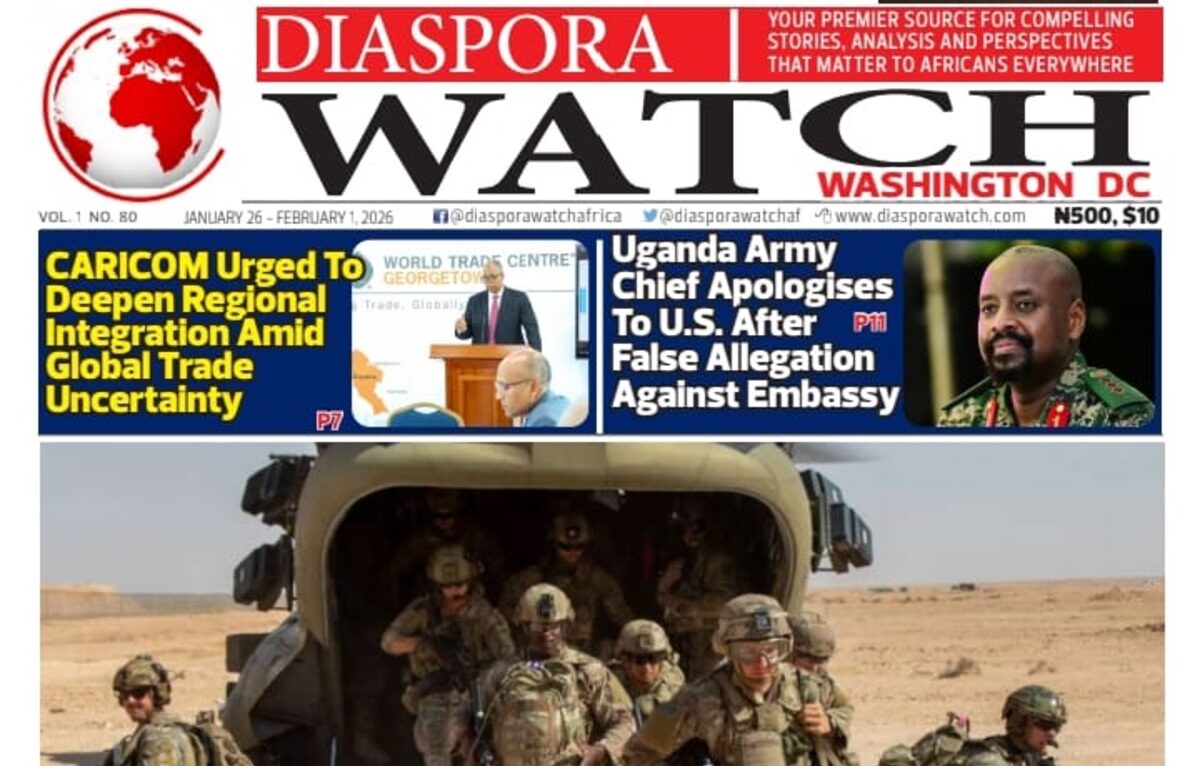
Diaspora Watch Newspaper has released its 81st edition, delivering a sharp, authoritative and globally attuned package of journalism that interrogates power, policy and influence at a critical moment in international affairs.
Diaspora Watch FREE DIGITAL VIEW: https://diasporawatch.com/3d-flip-book/diaspora-watch-vol-81/
On-Demand Print: https://www.magcloud.com/browse/issue/3259915?__r=1069759
SUBSCRIBE TO DIASPORA WATCH NOW ON THE LINK BELOW: https://diasporawatch.com/subscribe-to-diaspora-watch-newspaper/
This latest edition captures the shifting dynamics of global security, diplomacy and governance, with a lead focus on deepening U.S.–Nigeria security engagement against the backdrop of rising terror threats. The report probes the strategic calculations behind the move and what it means for regional stability, sovereignty and counter-terrorism cooperation in West Africa.
Beyond security, the edition reflects the volatility of a world in transition. From renewed uncertainty in Libya following reports surrounding Muammar Gaddafi’s son, to mounting tensions in the United States over federal immigration enforcement and public protest, Diaspora Watch situates breaking developments within their broader political and social contexts.
The newspaper also turns attention to the future, spotlighting technological innovation aimed at Africa’s digital inclusion, as well as urgent calls for stronger regional integration in the Caribbean amid global trade headwinds. Energy policy debates, evolving diplomatic relations between Africa and the United States, and the deepening humanitarian emergency in the Democratic Republic of Congo are examined with clarity, balance and depth.
Rounding out the edition is a culture-driven back-page story that blends politics, celebrity and controversy, underscoring how influence and perception increasingly intersect in the global public space.
With its 81st edition, Diaspora Watch Newspaper reinforces its position as a trusted platform for diaspora-focused journalism—bold in perspective, rigorous in reporting and committed to telling Africa’s story within a rapidly changing world.
Stay connected with the world around you – read Diaspora Watch today!
Celebrating African excellence and spotlighting pressing global issues.
#DiasporaWatch #AfricaInFocus #GlobalNews #CulturalVoices #AfricanPerspective


CARICOM pushes unified response to global shifts, backs Guyana’s COP35 bid

Nigeria’s Stakes in a Fractured Middle East, by Boniface Ihiasota

The United States, Israel and the Iran Question, by Alabidun Shuaib AbdulRahman

Pastor Jerry Eze Defends Miracles At UK Conference Amidst Criticism And Controversy

Diaspora Watch 20th Edition (October 14-20, 2024): Your Trusted Source for Global News and Insights


