
Diaspora
Former Eritrean Finance Minister And President’s Fierce Critic, Berhane Abrehe, Dies In Prison


Berhane Abrehe, a former Eritrean finance minister and vocal critic of President Isaias Afwerki, has died in prison, his family confirmed. The 79-yearold was Eritrea’s longest-serving finance minister before his removal in 2012 due to clashes with the president. He was later jailed in 2018 for publishing a book that described President Afwerki as a “dictator” who needed to resign.
Abrehe’s family has not been informed of the circumstances surrounding his death, and his body has not been released. The government rarely confirms the deaths of senior officials in custody or shares information on their burial sites.
Abrehe’s fall-out with President Afwerki began during his 12-year tenure as finance minister, where he advocated for transparency in the country’s budget. After his removal, he wrote a book challenging the president’s rule and calling for his resignation.
Eritrea has been criticized for its human rights record, including torture, forced disappearance, and imprisonment of tens of thousands of people in inhumane conditions. The UN and human rights groups have accused the government of gross human rights violations.
Abrehe’s death highlights the country’s poor human rights record and the risks faced by those who dare to criticize the government.
Born in Eritrea in 1945, Abrehe earned an MA degree in economics from a US university before joining the struggle for independence from Ethiopia. He is the father of four children.
His family, including his wife and son, have also faced persecution. His wife was imprisoned for a year, and his son, Efrem, fled the country and now lives in the US.
Read also : CARICOM Ministers Boost Food Security & Climate Action at Caribbean Week of Agriculture
Efrem previously described his family’s ordeal to the BBC, saying, “I am living with a dim glimmer of hope that my father, who has health issues, [will be out of prison one day]. How can people be kidnapped by a government and disappear for years? Why do people show such cruelty on a fellow human like this?”
Abrehe’s death is a stark reminder of the dangers faced by those who speak out against the Eritrean government.


Duckie Thot has become one of the most recognisable faces in global fashion, admired for her striking beauty and strong presence on international runways. Born Nyadak Thot on October 23, 1995, in Melbourne, she is of South Sudanese heritage and grew up in Australia after her family fled conflict in South Sudan before her birth.
Thot first gained public attention in 2013 when she competed in Australia’s Next Top Model, finishing as one of the top contestants. Al-though the exposure helped launch her career, she initially struggled to secure opportunities in Australia, which she attributed to limit-ed representation for models of colour in the local fashion industry.
Determined to pursue her dream, she later relocated to New York, where her career quickly gained momentum. A breakthrough moment came when she was invited to work with Kanye West, leading to her runway debut at the Yeezy Spring/Summer 2017 show. Since then, she has walked for major fashion houses and featured in campaigns for brands including Fenty Beauty, Balmain and Moschino.
Her profile rose further when she starred as Alice in the 2018 Pirelli Calendar in-spired by Alice’s Adventures in Wonderland. The project, which featured an all-Black cast, celebrated diversity in fashion and helped cement Thot’s reputation as one of the industry’s most influen-tial models.Beyond modelling, Thot has also been vocal about di-versity and inclusion in the beauty and fashion world. Having once struggled to find makeup suited to her skin tone on photo shoots, she now advocates for broader repre-sentation behind the scenes and on the runway, inspiring a new generation of models to see themselves reflected


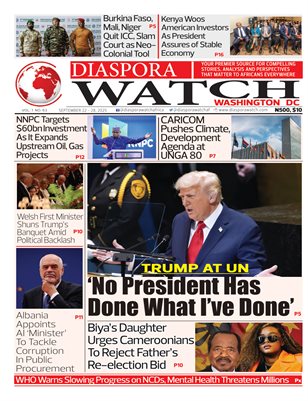
Diaspora Watch Newspaper Rolls Out 86th Edition
Diaspora Watch Newspaper announces the publication of its 86th edition, a robust compilation of major global developments, policy debates, and defining moments across politics, economy, and culture.
Diaspora Watch FREE Digital View: https://diasporawatch.com/3d-flip-book/diaspora-watch-vol-86/
On Demand Print: https://www.magcloud.com/browse/issue/3294104?__r=1069759
SUBSCRIBE TO DIASPORA WATCH NOW ON THE LINK BELOW !!!
https://diasporawatch.com/subscribe-to-diaspora-watch-newspaper/
Leading the edition is a striking governance story from Madagascar, where the President has proposed the use of lie detector tests for cabinet members—an unprecedented move that has ignited conversations around transparency and executive accountability.
Also headlining the front page is the uncertainty surrounding U.S. President Donald Trump’s claims of engagement with Iran, a development that has triggered mixed reactions and heightened global attention amid already fragile diplomatic dynamics.
In Europe, Hungary has launched an official investigation following claims that its Foreign Minister was subjected to illegal wiretapping, raising serious questions about privacy, state surveillance, and political intrigue. In a related development, Trump has stirred further controversy after sharing a satirical skit mocking British Prime Minister Keir Starmer, even as sensitive discussions around the Iran situation continue.
On the international stage, China has cautioned the United States and Israel against escalating crises, invoking lessons from the Iraq War as a warning against the far-reaching consequences of military conflict.
From Africa, the World Health Organization has confirmed the deaths of 64 individuals in a hospital attack in Sudan, highlighting the deepening humanitarian emergency in the region. Additionally, African governments are intensifying efforts to regulate the digital economy, with new moves to tax online gambling platforms facing resistance from industry operators.
In the Caribbean, the private sector has lauded Afreximbank’s $5 billion investment pledge, describing it as a transformative initiative expected to strengthen economic cooperation and unlock new opportunities for growth within the region.
Completing the edition, the back page celebrates global pop culture, as bold, feather-inspired fashion takes center stage at the Oscars red carpet, reflecting creativity and evolving style narratives in the entertainment industry.
This edition reinforces Diaspora Watch Newspaper’s dedication to delivering authoritative journalism, in-depth analysis, and stories that matter to a global audience.
Stay Informed and ahead of the curve with the 50th edition of Diaspora Watch, where we explore the complex dynamics shaping our world and provide insights into the stories that matter.
Stay connected with the world around you – read Diaspora Watch today!
Celebrating African excellence and spotlighting pressing global issues.
#DiasporaWatch #AfricaInFocus #GlobalNews #CulturalVoices #AfricanPerspective


Zenith Bank Plc has announced a Diaspora engagement programme aimed at providing essential banking and identity services to Nigerians residing in the United States, with activities scheduled to hold in Houston and Dallas, Texas.
The initiative, according to information obtained by Diaspora Watch Newspaper, targeted at Nigerians in the diaspora, is designed to ease access to banking services and strengthen financial inclusion among citizens living abroad.
The programme will feature free Bank Verification Number (BVN) enrolment, National Identification Number (NIN) enrolment, seamless account opening, account reactivation, and digital banking onboarding.
Diaspora Watch Newspaper further gathered that participants will also benefit from mobile and internet banking activation, instant debit card issuance, and access to mortgage products offered at concessionary rates.
The engagement will further provide a platform for interaction with IT experts, creatives, influencers, and other service exporters, in line with efforts to deepen diaspora participation in Nigeria’s economy.
The Houston leg of the exercise will take place at the Hilton Houston Post Oak by the Galleria on February 24, 25 and 28, 2026, while another session will hold at The Ion, 4201 Main Street, Houston, on February 26 and 27, 2026.
The Dallas session is scheduled for March 3, 4 and 5, 2026, at the Sheraton Dallas Hotel by the Galleria.
Activities are expected to run daily from 9:00am to 6:00pm. Prospective participants have been advised to come along with valid proof of address as stipulated in the registration requirements.
Zenith Bank noted that the programme forms part of its ongoing diaspora banking strategy, aimed at supporting Nigerians abroad with convenient access to financial services and fostering stronger economic ties between the diaspora community and Nigeria.
For further enquiries, interested individuals are encouraged to contact Zenith Bank’s Diaspora Banking desk via WhatsApp or telephone, or through the official diaspora banking email.
Register for the event: JOIN ZENITH BANK IN THE UNITED STATES OF AMERICA TEXAS
Website: https://www.zenithbank.com
WhatsApp/call: +234 913 107 2967
Zenith Bank to Host Diaspora Engagement, Banking Services for Nigerians in Texas




Pastor Jerry Eze Defends Miracles At UK Conference Amidst Criticism And Controversy

Diaspora Watch 20th Edition (October 14-20, 2024): Your Trusted Source for Global News and Insights

Tanzanian Man Reportedly Dies And Returns To Life Six Times


-

 Trending5 days ago
Diaspora Watch – Vol. 87
-

 News5 days ago
Artemis II Crew Captures Stunning Images of Earth Midway to Moon
-

 Analysis5 days ago
Understanding South Africa’s Xenophobic Violence, by Alabidun Shuaib AbdulRahman
-

 News5 days ago
US, Iran Search for Missing Airman After Warplane Downed
-

 News5 days ago
Melania Trump Rallies 45 Nations on AI-powered Education
-

 Features5 days ago
Blood in Jos Again? By Boniface Ihiasota