
Business
Global Competition Claims Scotland’s Oldest Refinery: Grangemouth To Close In 2025


In a significant blow to Scotland’s energy sector, the 100-year-old Grangemouth refinery is set to close in 2025, citing its inability to compete with modern plants in Africa, Asia, and the Middle East. The refinery’s operator, Petroineos, announced the closure, which will result in the loss of 400 jobs.
Located in Scotland, Grangemouth refinery has been in operation since 1924, making it the country’s oldest and only refinery. However, despite its rich history, the refinery has struggled to remain competitive in the face of mounting global competition. Petroineos, a joint venture between PetroChina Internation al London (PCIL) and INEOS Group, a British chemicals firm founded by billionaire Sir Jim Ratcliffe, has invested $1.2 billion in the refinery since 2011.
However, the company has incurred significant losses, totalling over $775 million during the same period. According to Petroineos, the refinery is currently losing around $500,000 per day and expects a $200 million loss in 2024.
The company’s Chief Executive, Frank Demay, stated that the market for petrol and diesel fuels is expected to shrink further due to the upcoming ban on new petrol and diesel cars within the next decade. “Grangemouth is increasingly unable to compete with bigger, more modern and efficient sites in the Middle East, Asia and Africa.
Due to its size and configuration, Grangemouth incurs high levels of capital expenditure each year just to maintain its licence to operate,” Demay explained. The closure of Grangemouth refinery marks a significant shift in the global oil refining landscape, with modern and efficient plants in Africa, Asia, and the Middle East gaining a competitive edge. The Dangote Refinery in Nigeria, one of the largest refineries in Africa, may have contributed to the decline of Grangemouth refinery.
The refinery will be converted into a fuel import terminal, ensuring Scotland’s energy needs are still met. However, the closure raises concerns about the country’s energy security and the impact on local communities.
Read Also
Oando PLC Makes Historic Acquisition Of Nigerian Agip Oil Company,
Reshaping Nigeria’s Oil And Gas Landscape





Tesla Loses Top Spot as BYD Overtakes in Global EV Sales
Tesla has reported lower-than-expected vehicle sales in the fourth quarter of 2025, losing its position as the world’s largest electric vehicle (EV) maker by annual sales to Chinese auto giant, BYD.
The American EV manufacturer, led by billionaire entrepreneur Elon Musk, said it delivered 418,227 vehicles in the final three months of 2025, bringing its total deliveries for the year to about 1.64 million units.
In contrast, a day earlier, Shenzhen-based BYD announced that it sold 2.26 million electric vehicles in 2025, overtaking Tesla to emerge as the global market leader in EV sales.
Analysts had projected a stronger performance from Tesla in the fourth quarter, with a FactSet consensus estimating deliveries of about 449,000 vehicles.
The shortfall has heightened concerns over slowing demand for electric vehicles, particularly in the United States.
Industry analysts noted that the removal of the $7,500 federal EV tax credit at the end of September 2025 has continued to weigh on consumer demand in the US market, with the sector yet to find a new equilibrium.
However, observers point out that Tesla’s sales challenges predated the policy change, as the company had already been struggling in some key markets.
This, analysts said, was partly linked to the political activities of its chief executive, Elon Musk, including his public support for US President Donald Trump and other far-right politicians, which reportedly affected consumer sentiment.
Tesla is also facing intensifying competition from Chinese manufacturers, particularly BYD, as well as from established European automakers ramping up their EV offerings.
BYD, which produces both fully electric and hybrid vehicles, on Thursday disclosed that it recorded its highest-ever EV sales in 2025, underlining the growing dominance of Chinese firms in the global electric vehicle market.
The development signals a major shift in the rapidly evolving EV industry, with analysts predicting stiffer competition and further pressure on global automakers in the coming year.

FG Targets One Exportable Product per LGA as Nigeria Deepens AfCFTA Push in 2026
The Federal Government has unveiled plans to deepen Nigeria’s participation in the African Continental Free Trade Area (AfCFTA) in 2026, with a strategy aimed at identifying at least one exportable product in each of the country’s 774 local government areas.
The initiative, according to an official report, is designed to scale up production at the grassroots, boost non-oil exports and strengthen Nigeria’s competitiveness within the African market under the continent-wide trade agreement.
The plan forms a major pillar of the Nigeria AfCFTA Agenda for 2026, building on implementation milestones recorded in 2025 and reflecting the government’s resolve to fully harness opportunities created by the AfCFTA framework.
Implementation of AfCFTA in Nigeria is being overseen by the Minister of Industry, Trade and Investment, Dr Jumoke Oduwole, and operationalised through the AfCFTA Central Coordination Committee (CCC), in collaboration with development partners across the public and private sectors.
As part of efforts to stimulate AfCFTA-oriented production nationwide, the Ministry of Industry, Trade and Investment and the CCC are set to embark on a nationwide awareness and sensitisation campaign targeting states, local governments and key economic actors.
“FMITI will work with the Nigerian Governors’ Forum and State Governments to identify a minimum of one product that each Local Government Area can export into the AfCFTA market,” the report stated.
Beyond boosting local production, the 2026 AfCFTA agenda places strong emphasis on creating an enabling policy and regulatory environment to support the effective implementation of the AfCFTA Agreement and its protocols.
The Ministry of Industry, Trade and Investment is expected to lead efforts to align domestic regulations with continental trade rules.
The report also highlights plans to simplify AfCFTA rules and compliance requirements through targeted publications and guides for businesses, particularly small and medium-scale enterprises, while strengthening institutional coordination and improving accountability among public sector agencies involved in trade facilitation.
On investment and industrial capacity, the document noted that investment mobilisation efforts, both foreign and domestic, will focus on significantly expanding productive capacity in priority sectors to position Nigeria as a leading innovation, production and distribution hub within the AfCFTA market.
In addition, Nigeria plans to upgrade its trade data systems to enhance tracking of AfCFTA trade flows, including disaggregated data on goods, services and participation by women and youth.
The country will also intensify global advocacy efforts and host key continental trade engagements ahead of the Intra-African Trade Fair scheduled for 2027.
The government expressed optimism that the 2026 agenda will accelerate inclusive growth, deepen regional integration and strengthen Nigeria’s leadership role in intra-African trade.

Understanding Nigeria’s Tax Reforms from the Diaspora Lens, by Boniface Ihiasota
Over the past year, Nigeria’s fiscal landscape has undergone one of its most significant overhauls in decades. With the Nigeria Tax Act (NTA) 2025, Nigeria Tax Administration Act (NTAA) 2025, Nigeria Revenue Service (Establishment) Act (NRSEA) 2025, and the Joint Revenue Board (Establishment) Act (JRBEA) 2025 all gazetted and taking effect from January 2026, Nigerians both at home and abroad have stirred in intense debate about what the new tax regime means for them.
For Nigerians in the diaspora, often seen as economic anchors through remittances, investment, skills, and global network strengths, the anxieties have been palpable. But beneath the political rhetoric and social media speculation lies a set of rational, fact-based realities that deserve sober reflection.
At the heart of the concerns was a simple question: Will Nigerians abroad now be taxed simply because they are citizens, earn income abroad, or send money home? The answer, based on official clarifications from the government’s Presidential Fiscal Policy and Tax Reforms Committee, is a resounding no — provided certain conditions are met.
Under the new tax framework, tax liability is tied to residency and source of income, not nationality. Nigeria uses the widely accepted 183-day rule to determine tax residency: an individual who spends 183 days or more in Nigeria within any 12-month period is treated as a tax resident and may be liable to tax on their worldwide income. A Nigerian living predominantly overseas is therefore generally classified as a non-resident for tax purposes.
For non-residents, the guiding principle is simple: only income derived from Nigerian sources such as business profits within Nigeria, rental income from Nigerian property, dividends from Nigerian companies, or other Nigeria-sourced earnings is taxable in Nigeria. Income earned entirely abroad, even if remitted into Nigeria, is not taxable under the new law.
This principle aligns with international norms and double taxation prevention practices, ensuring that non-residents are not taxed twice on the same earnings. Nigeria has signed Double Taxation Agreements (DTAs) with many countries to further cement this protection, and in cases where no treaty exists, unilateral relief provisions now apply.
Perhaps the most emotionally charged topic for families across Nigeria and its global diaspora has been remittances, the lifeblood of many households and a key stabilizer of local economies. According to reports from the International Organization for Migration and other development institutions, Nigeria received over $20 billion in remittances in 2024 alone, making it one of the largest recipients globally.
The good news for diaspora Nigerians is that personal remittances, family transfers, gifts, refunds, and community contributions are explicitly not treated as taxable income under the new laws. They fall outside the definition of income because no services were rendered in exchange, meaning such inflows do not attract income tax.
This clarification is huge symbolically and economically. It stabilizes diaspora-to-home financial support channels and removes the fear that sending money to loved ones could attract punitive tax liabilities.
One point of confusion early in the rollout of the tax reforms was whether diaspora Nigerians were required to obtain a Tax Identification Number (TIN) or file annual returns. The government has clarified that Nigerians abroad who do not earn Nigerian-sourced income are not required to get a TIN or file returns simply by virtue of being diaspora citizens.
A TIN becomes relevant only when an individual earns income that is subject to Nigerian tax — for example, if they operate a business in Nigeria, receive Nigerian rents or dividends, or are otherwise engaged in Nigerian economic activities. In such cases, the government has made compliance simpler through digital platforms like TaxProMax, enabling remote TIN registration and electronic filing.
Under the new regime, pensions or stipends from abroad are not taxed in Nigeria unless they relate to employment performed in Nigeria. Similarly, income earned by remote workers employed by foreign entities is taxed in the country where the work is performed or where the worker resides, not in Nigeria.
Investment income like dividends, rental profits from property in Nigeria, or capital gains can be taxable, but they are subject to specific exemptions, withholding tax rates, and treaty-based withholding reductions, depending on the country of residence and the nature of the income.
For many Nigerians living abroad, these tax clarifications provide both relief and opportunity. They remove the threat of arbitrary taxation on diaspora earnings and remittances, uphold the principle that tax should be fair, linked to economic presence and source of income, and provide clear rules on compliance and obligations. This clarity could encourage greater diaspora engagement in investment, return visits, knowledge transfer, and even relocation — all of which can contribute to national development.
However, the reforms also underscore the importance of understanding one’s tax status, especially for diaspora members who maintain business interests, property, or other income-generating activities in Nigeria. In such cases, proactive compliance and professional tax guidance remain vital.
In conclusion, while tax changes can stir anxiety, the new framework ultimately protects the financial interests of Nigerians abroad, aligns Nigeria with global tax practices, and provides a structure that facilitates, rather than inhibits, diaspora contributions to national progress.


Nigeria to Court-Martial Officers Over Alleged Coup Plot Against President Tinubu

Iran Signals Readiness for Both War and “Fair Negotiations” with United States

Niger Junta Blames France, Benin, Ivory Coast for Deadly Airport Attack

Pastor Jerry Eze Defends Miracles At UK Conference Amidst Criticism And Controversy

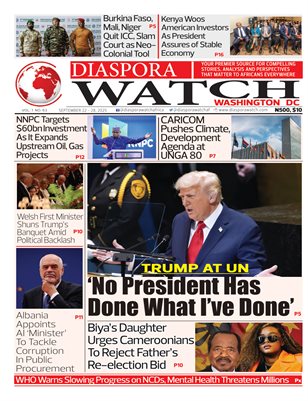
Diaspora Watch 20th Edition (October 14-20, 2024): Your Trusted Source for Global News and Insights

Tanzanian Man Reportedly Dies And Returns To Life Six Times


-

 Analysis6 days ago
The Agony of a Columnist, by Alabidun Shuaib AbdulRahman
-

 Analysis5 days ago
Now That Nigeria Has a U.S. Ambassador-Designate, by Boniface Ihiasota
-

 Diplomacy5 days ago
CARICOM Raises Alarm Over Political Crisis in Haiti
-

 News6 days ago
Macron invites Chad’s Déby to Paris amid push to reset ties
-

 News6 days ago
Tinubu Unhurt After Brief Stumble at Turkey Reception
-

 News6 days ago
Court, Congress Pile Pressure on DHS Over Minnesota Operations