
Health
World Health Organization Adopts First-Ever Pandemic Agreement

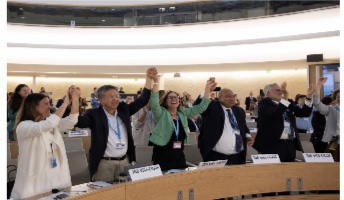
The World Health Organization’s (WHO) Member States have formally adopted the world’s first Pandemic Agreement, marking a significant milestone in the global response to pandemics.
The agreement, adopted by consensus at the 78th World Health Assembly, aims to make the world safer and more equitable in response to future pandemics.
WHO Director-General, Dr. Tedros Ghebreyesus, hailed the adoption of the Pandemic Agreement as a “victory for public health, science, and multilateral action.”
He emphasized that the agreement will enable the international community to better protect the world from future pandemic threats and ensure that citizens, societies, and economies are not left vulnerable to suffer losses like those endured during COVID-19.
The Pandemic Agreement sets out principles, approaches, and tools for better international coordination across a range of areas, including equitable access to vaccines, therapeutics, and diagnostics.
The agreement emphasizes the importance of ensuring timely and equitable access to life-saving pandemic-related health products while respecting national sovereignty.
The adoption of the Pandemic Agreement marks the beginning of a new era of global health cooperation.
An Intergovernmental Working Group will be established to develop a Pathogen Access and Benefit Sharing (PABS) system, which will be considered at next year’s World Health Assembly. After 60 ratifications, the agreement will enter into force.
Dr. Teodoro Herbosa, Secretary of the Philippines Department of Health and President of this year’s World Health Assembly, noted that now that the Agreement has been brought to life, all parties must act with the same urgency to implement its critical elements, including systems, to ensure equitable access to life-saving pandemic-related health products.
The Pandemic Agreement offers a once-in-a-lifetime opportunity to build on lessons learned from the COVID-19 pandemic and ensure that people worldwide are better protected if a future pandemic emerges.
The agreement’s emphasis on equitable access to health products, national sovereignty, and international cooperation will help to ensure that the world is better prepared to face future pandemic threats.











Africa CDC, WHO demand urgent scale-up of DRC Ebola response
The Africa Centres for Disease Control and Prevention and the World Health Organisation have called for an urgent scale-up of the community-led response to the Ebola outbreak in the Democratic Republic of the Congo.
The organisations said the response must focus on early detection, contact tracing, access to treatment, protection of frontline health workers and faster deployment of resources to affected communities.
The call followed a joint high-level mission to Uganda and the DRC on August 4 and 5, led by the WHO Director-General, Dr Tedros Adhanom Ghebreyesus; Director-General of Africa CDC, Dr Jean Kaseya; and WHO Regional Director for Africa, Dr Mohamed Janabi.
The delegation visited Kampala, Bunia and Kinshasa, where it held discussions with government officials, response coordinators, health workers, community representatives and development partners.
In Uganda, the delegation commended the country for successfully containing local transmission after it declared the end of its outbreak on July 28.
Uganda recorded 20 confirmed cases and two deaths, while all identified contacts completed their follow-up.
The organisations said Uganda’s experience demonstrated the importance of early detection, rapid contact tracing, coordinated government action, community engagement and effective cross-border surveillance.
However, they warned that continued transmission in the DRC meant neighbouring countries remained at risk and should maintain surveillance, laboratory readiness and cross-border coordination.
The delegation subsequently travelled to Bunia, the epicentre of the outbreak in Ituri Province, where it met provincial authorities, health workers, community leaders and response partners.
It also visited the Rwangole Ebola Treatment Centre to assess its readiness to expand access to timely and quality care.
The delegation stressed that communities would play a central role in containing the outbreak, urging authorities to ensure that residents receive accurate information from trusted sources and can report suspected cases and seek treatment without fear.
It also identified community, religious, women and youth leaders as critical partners in building confidence and ensuring that response measures reflect local realities.

US raises Ebola response to highest level as Congo outbreak worsens
The United States Centers for Disease Control and Prevention has raised its emergency response to the ongoing Ebola outbreak in the Democratic Republic of Congo to its highest activation level, citing growing concerns over the rapid spread of the disease, even as it maintained that the risk to the American public remains low.
The CDC announced on Friday that it had elevated its emergency operations to Level 1, its highest response category, a designation reserved for the most critical public health emergencies requiring the agency’s maximum personnel and resources.
The decision follows a sharp increase in infections linked to the Bundibugyo strain of the Ebola virus, which has so far infected more than 1,200 people in the Democratic Republic of Congo and claimed 321 lives.
The outbreak has also spread across the border into Uganda, where 20 confirmed cases have been recorded, according to the World Health Organization.
The WHO said the current outbreak has produced the highest number of cases recorded within the first month of any Ebola outbreak.
Despite the escalation, the CDC stressed that the likelihood of the virus spreading within the United States remains low.
Speaking during a media briefing, the CDC’s Ebola Incident Manager, Dr. Satish Pillai, said the agency had already deployed 19 personnel overseas to strengthen response efforts in the affected countries.
According to him, the deployed experts are supporting more than 125 CDC staff already working through the agency’s country offices in the Democratic Republic of Congo and Uganda.
He said the teams were collaborating with health ministries in both countries on disease surveillance, laboratory testing, airport exit screening, data analysis and the training of frontline health workers.
The CDC noted that Level 1 emergency activation has previously been used during major public health and humanitarian crises, including Hurricane Katrina in 2005, the 2009-2010 H1N1 swine flu pandemic, the 2014-2016 West African Ebola epidemic and the 2016-2017 Zika virus outbreak.
Meanwhile, the White House is seeking more than $1.4bn in emergency funding from the US Congress to strengthen the country’s response to the expanding outbreak.
According to a Trump administration official, the proposed funding package includes $800m to establish a quarantine facility in Kenya for Americans who may have been exposed to the Ebola virus while abroad.


Parents have been advised to adopt simple, creative activities to keep toddlers engaged during the summer holidays, as experts warn that boredom and inactivity can affect children’s development and behavior.
The advice follows concerns that many parents struggle to manage toddlers’ high energy and curiosity when schools are closed and outdoor play becomes limited due to harsh weather conditions.
Child development specialists noted that engaging toddlers in playful, home-based activities not only keeps them occupied but also supports their mental, physical and emotional growth during the holiday period.
Among the recommended activities is water play, which involves allowing children to interact with water
using cups, spoons and toys, a method said to improve motor skills and coordination while keeping them cool and entertained.
Experts also noted coloring, storytelling and building blocks as effective ways to boost creativity, focus and imagination, stressing that such activities encourage children to express themselves and gradually improve their attention span.
Other suggested activities include indoor obstacle courses, pretend play, music and dance sessions, as well as simple sorting games, all of which help toddlers develop physical strength, communication abilities and problem-solving skills.
They emphasized that play remains a critical tool for early childhood development, stressing that toddlers learn more effectively through interactive and enjoyable experiences than through formal teaching methods, as it enhances brain development, language acquisition, social skills and creativity.


RWE abandons US offshore wind projects in $1.2bn Trump deal

Saudi Arabia, Turkey, Pakistan sign defence pact amid Middle East tensions

Africa CDC, WHO demand urgent scale-up of DRC Ebola response

Pastor Jerry Eze Defends Miracles At UK Conference Amidst Criticism And Controversy

Diaspora Watch 20th Edition (October 14-20, 2024): Your Trusted Source for Global News and Insights

Tanzanian Man Reportedly Dies And Returns To Life Six Times


-

 Milestone1 week ago
Nigerian bags HVAC Engineering degree in US, lands full-time job
-

 News1 week ago
CARICOM chair renews reparations demand
-
 Analysis1 week ago
Lessons from the Catholic Bishops’ Visit to Tinubu, by Boniface Ihiasota
-

 Analysis1 week ago
Obasanjo, Atiku and the Burden of Broken Trust, by Alabidun Shuaib AbdulRahman
-
 News1 week ago
Hamas agrees to disarm as Gaza withdrawal deal gains momentum
-

 Opinion1 week ago
EDITORIAL: Tackling Poverty in Africa