
Diplomacy
Tinubu In Paris: Macron Dinner, Investment Push, Mambilla Victory

Tinubu In Paris: Macron Dinner, Investment Push, Mambilla Victory
By Alabidun Shuaib AbdulRahman
Nigeria’s President Bola Ahmed Tinubu’s second leg of his three-week European leave in Paris has evolved into more than a stop in the French capital, with high-level diplomatic engagement, renewed investment discussions, digital-economy initiatives and a major arbitration victory for Nigeria converging around the President’s stay.
Tinubu arrived in Paris on Sunday, September 13, after spending the first phase of his annual leave in London. He was received by Nigeria’s Ambassador to France, Ayodele Oke, as the Presidency maintained that the trip was a working vacation ahead of the President’s return to Nigeria.
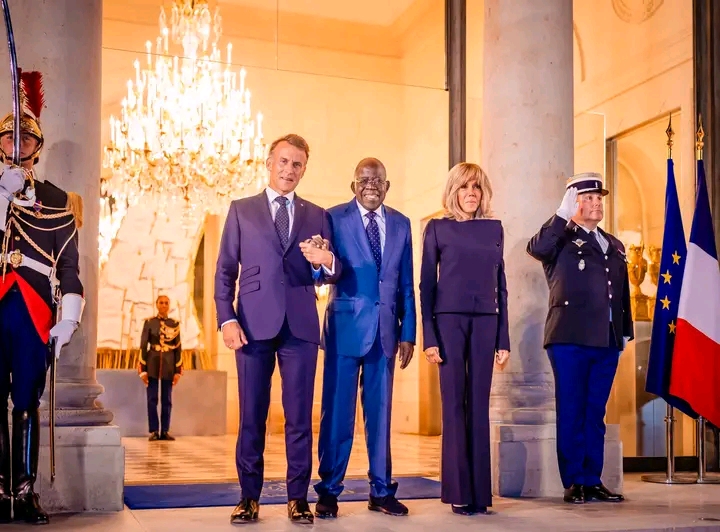
The Paris leg assumed a distinctly diplomatic character on Thursday, September 17, when French President Emmanuel Macron received Tinubu for a private dinner at the Élysée Palace.
Although details of the private discussions were not released, the Presidency said the encounter reflected the longstanding relationship between Nigeria and France and the two countries’ shared commitment to strengthening bilateral cooperation.
Photographs released from the meeting showed Tinubu with Macron and France’s First Lady, Brigitte Macron.
The engagement was significant against the backdrop of a relationship that has expanded considerably since Tinubu assumed office in May 2023.
France’s Ministry for Europe and Foreign Affairs describes Nigeria as an important partner because of its demographic, economic, cultural and political weight in Africa.
The ministry says bilateral relations have intensified substantially since 2014, particularly in economic and cultural affairs.
France also identifies Nigeria as its largest trading partner in sub-Saharan Africa, accounting for about 20 per cent of France’s trade with the region.
Bilateral trade stood at €5.1bn in 2023, according to French government figures.
The latest Macron-Tinubu engagement therefore came against an established diplomatic framework rather than as an isolated presidential encounter.
Tinubu’s previous major engagement with France included his November 2024 state visit, during which the two countries signed declarations of intent covering economic cooperation, sustainable and solidarity-based investment, critical minerals, banking and the cultural and creative industries.
France also recalls Tinubu’s June 2023 visit to Paris for the Summit for a New Global Financial Pact, his first official foreign trip after assuming office.
But the most tangible economic dimension of the current Paris stay emerged on Friday, September 18, when Tinubu met Vincent Bolloré, chairman of the Bolloré Group, for discussions on expanding the French conglomerate’s investments in Nigeria.
According to the Presidency, the discussions covered film, entertainment, fibre-optic infrastructure and the wider digital economy, with the group indicating plans to deepen the localisation of its operations in Nigeria.
The interests of the Bolloré Group include Canal+, MultiChoice and Universal Music Group, giving the meeting implications beyond conventional infrastructure investment and into Nigeria’s rapidly expanding entertainment, media and technology ecosystem.
For Tinubu, the argument is increasingly centred on converting Nigeria’s enormous cultural influence into domestic economic value.
The President said Nigeria’s global cultural reach through Nollywood, Afrobeats, fashion and other creative industries should translate into greater local production, investment, infrastructure and employment.
The Presidency said the discussions were also linked to the administration’s objective of ensuring that more of the value generated by Nigerian talent remains within the country.
The meeting with Bolloré consequently placed the creative economy alongside digital infrastructure as an emerging component of Nigeria’s investment diplomacy.
It was also consistent with another initiative announced during the Paris period: the movement of Nigeria’s Digital Free Zones programme into its implementation phase.
The initiative is designed to enable Nigerian technology and service companies to raise international capital, serve global markets and retain their businesses and intellectual property in Nigeria rather than relocating abroad.
Tinubu directed the Minister of Trade and Investment, Jumoke Oduwole, who is vice-chairman and implementation coordinator of the Presidential Steering Committee on Digital Free Zones, to work with the committee and Itana Innovation to develop a roadmap for the full launch of the programme within 180 days.
At the centre of the initiative is Itana, described by the Presidency as Nigeria’s first Digital Free Zone and already licensed by the Nigeria Export Processing Zones Authority.
The government said the Africa Finance Corporation is backing the $500m Itana Innovation project at Alaro City in Lagos, where an innovation campus, access to capital and ecosystem services are expected to support African digital businesses.
Tinubu’s pitch is that Nigeria should not merely produce the talent powering the global digital economy while the companies, intellectual property, capital and high-value jobs are domiciled elsewhere.
The President said the administration wanted companies to be incorporated, financed and governed from Nigeria while serving customers across Africa and the wider world.
That economic message ran parallel to an important legal development in Paris.
On Thursday, September 17, an International Chamber of Commerce arbitration tribunal sitting in Paris delivered an award in favour of Nigeria in the long-running dispute involving Sunrise Power and Transmission Company Limited over the Mambilla Hydroelectric Power Project in Taraba State.
The case had exposed Nigeria to claims running into billions of dollars.
Sunrise had sought $680m in one aspect of the dispute while a separate arbitration involved claims exceeding $2.7bn relating to the proposed 3,960-megawatt Mambilla project. The tribunal rejected the claims.
According to details reported from the award, the tribunal also rejected Sunrise’s $400m claim arising from a 2020 settlement agreement and ordered Sunrise and its promoter, Leno Adesanya, to reimburse Nigeria 75 per cent of its legal fees and expenses, amounting to about $11.82m.
The dispute dates back to an agreement connected with the proposed Mambilla project and subsequent arbitration proceedings initiated in 2017.
A 2020 settlement agreement later produced another dispute after the government did not make the agreed payment.
Reacting to the ruling, Tinubu commended Attorney-General and Minister of Justice, Lateef Fagbemi, the Federal Ministry of Justice and the Nigerian defence team led by Elizabeth Oger-Gross and Tolu Obamuroh.
He also acknowledged the testimony of former President Olusegun Obasanjo and the late former President Muhammadu Buhari, as well as former ministers Babatunde Fashola and Suleiman Adamu and other witnesses.
Tinubu described the decision as removing what he called the “single biggest legal hurdle” that had paralysed the Mambilla project for years.
The coincidence of the arbitration ruling with the President’s presence in Paris gave the French leg of his European leave an unusual international dimension, even though the arbitration was a judicial proceeding independent of Tinubu’s presidential engagements.
The Mambilla project itself remains one of Nigeria’s most ambitious proposed power developments.
The planned hydroelectric scheme in Taraba has long been associated with the country’s search for large-scale additions to its electricity generation capacity, but contractual and legal disputes have contributed to its prolonged uncertainty.
The developments in Paris also underline the breadth of Nigeria-France relations.
The relationship now extends beyond traditional diplomacy into investment, banking, critical minerals, culture, entertainment, technology and infrastructure.
French authorities have described Nigeria as an indispensable interlocutor in Africa, while successive Nigerian administrations have sought to leverage French capital and expertise across strategic sectors.
For Tinubu, the Paris stop consequently became a meeting point for several strands of his administration’s international economic diplomacy: attracting foreign capital, keeping Nigerian intellectual property at home, expanding the creative economy, strengthening digital infrastructure and protecting the country’s position in international commercial disputes.
Yet the circumstances surrounding the trip have also attracted domestic political attention.
Tinubu left Abuja on August 30 for a three-week annual leave, with London as his first destination and Paris as the second leg.
The Presidency had described the absence as a working vacation and said the President would return to Nigeria at the end of the period.
The President’s stay abroad also generated debate over the constitutional question of presidential delegation during an extended absence, with some political figures questioning why Vice-President Kashim Shettima had not been formally designated Acting President.
Those arguments were publicly advanced by critics and were separate from the diplomatic and economic engagements in Paris.
For France, however, the immediate story has been the continuation of a relationship that has steadily acquired greater strategic and commercial depth.
While for Nigeria, the Paris episode has produced a cluster of developments that extend well beyond a presidential dinner: renewed contact with the Élysée Palace, an investment conversation with one of France’s most influential business groups, an implementation push for digital free zones and an ICC ruling that rejected multibillion-dollar claims connected to one of the country’s biggest proposed power projects.



US withdraws diplomats’ families from Gulf amid Houthi attacks
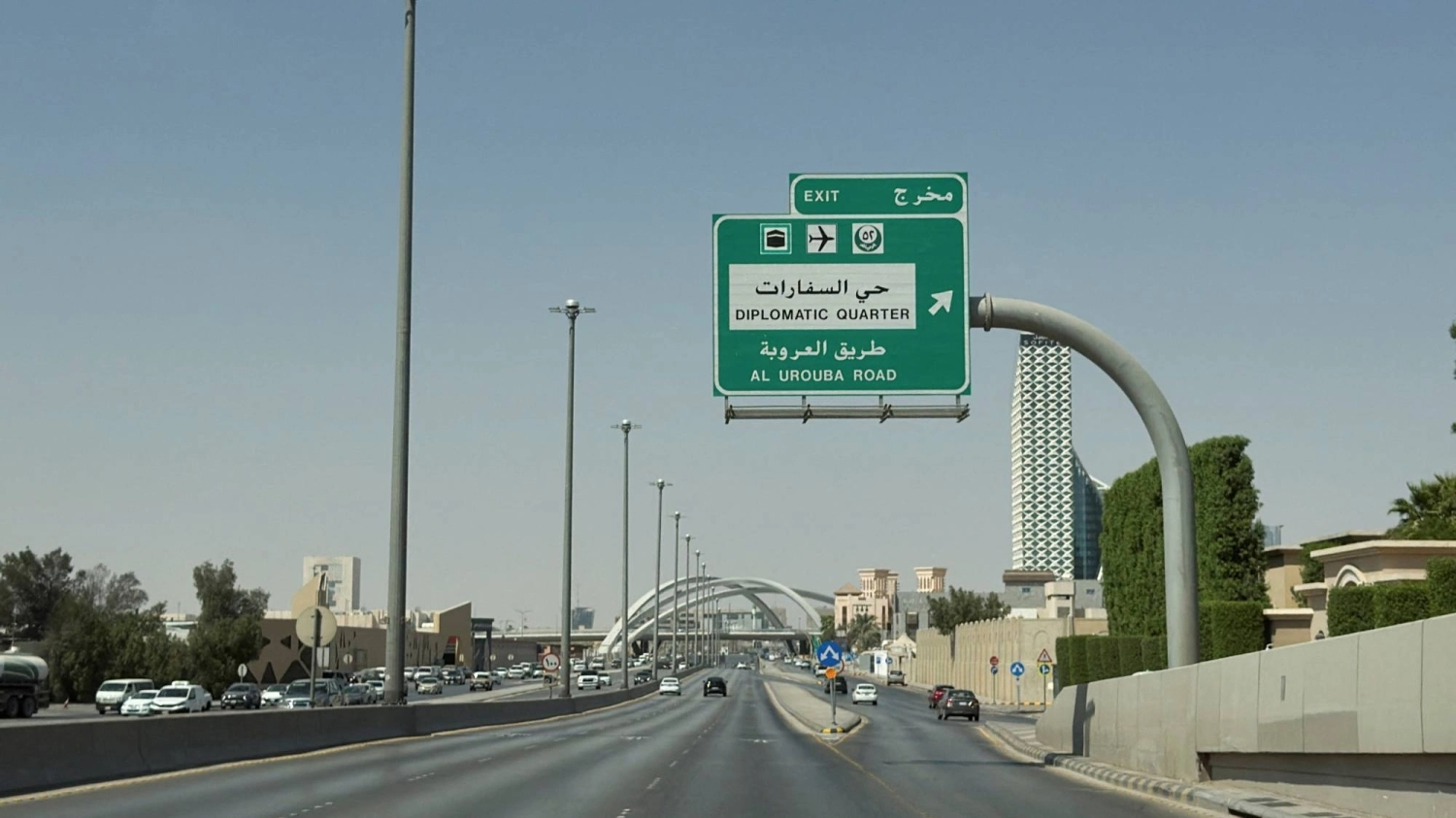
The United States has ordered non-emergency government employees and their families to leave its diplomatic missions in Saudi Arabia following deadly attacks on the kingdom’s airport and oil infrastructure.
The decision comes amid escalating regional tensions and concerns over further attacks by Iran-aligned Houthi forces, with Washington also planning to withdraw family members from its missions in other Gulf countries.
US State Department spokesman Tommy Pigott said the department had ordered the departure of non-emergency American government employees and their families in Saudi Arabia, citing attacks on civilian targets and critical infrastructure.
The attacks killed at least three people and injured eight others, according to Saudi authorities.
One person was killed and eight others injured in an attack on King Fahd International Airport in Dammam, while two people died in a drone attack targeting a facility at Saudi Aramco’s Shaybah oilfield.
Four US officials told Reuters that American missions in other Gulf states would also order family members to leave. Pigott, however, did not confirm changes to diplomatic missions outside Saudi Arabia.
The latest development follows an escalation of fighting in Yemen amid a wider regional conflict triggered by the US-Israeli war on Iran, which began in late February.
The conflict has disrupted global energy trade and heightened security concerns across the Gulf, a region central to international oil supplies and shipping.
Saudi Arabia’s energy ministry said its air defences intercepted a drone attempting to strike a facility at the Shaybah oilfield, resulting in two deaths.
The country’s civil aviation authority separately reported the deadly attack on King Fahd International Airport.
The US Embassy in Riyadh had earlier issued a security alert warning of possible further Houthi attacks following deadly strikes, including an attack on Riyadh’s airport.
The embassy and a Central Intelligence Agency station operating from the facility were also targeted by drones in early March, as Iran launched attacks across the region.
The withdrawal order signals Washington’s growing concern over the security of its personnel as attacks threaten civilian facilities, diplomatic installations and energy infrastructure across the Gulf.
CARICOM, Türkiye explore cooperation in trade, energy, food security
The Caribbean Community, CARICOM and the Republic of Türkiye have explored opportunities to strengthen cooperation in trade, investment, food security, renewable energy, disaster management and maritime connectivity.
The two sides also identified health, port development and climate resilience as priority areas for deeper engagement during the second meeting of the CARICOM-Republic of Türkiye Consultation and Cooperation Mechanism held on October 12, 2026.
According to a joint press release, the meeting reaffirmed both parties’ commitment to strengthening political dialogue and advancing practical cooperation in areas of mutual interest.
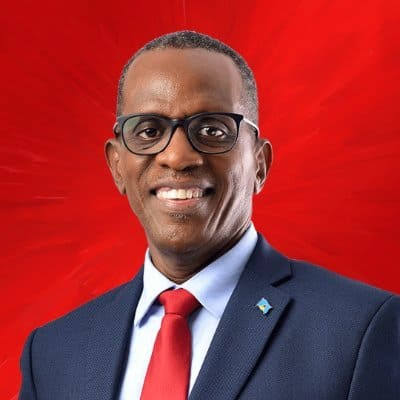
The meeting was co-chaired by the Permanent Secretary in Suriname’s Ministry of Foreign Affairs, International Business and Cooperation, Ambassador Miriam Mac Intosh, and Türkiye’s Director-General for Latin America and the Caribbean in its Ministry of Foreign Affairs, Ambassador Erkan Aytun.
Mac Intosh, who represents the current chair of the CARICOM Council for Foreign and Community Relations, said the partnership was founded on constructive dialogue, mutual respect and a shared commitment to development.
She commended Türkiye for its support for development projects and humanitarian assistance across the Caribbean, noting that the contributions had delivered tangible benefits to the region.
“We remain committed to identifying and advancing further initiatives that contribute to the Region’s resilience and sustainable development,” she said.
Convened under a memorandum of understanding signed in 2011, the meeting reviewed developments in relations between the two parties and examined opportunities to expand cooperation.
High-level officials from CARICOM member states presented practical proposals covering trade and investment, disaster management, food security, renewable energy, health, maritime connectivity and port development.
Representatives of Turkish institutions also outlined how their technical expertise, technology and institutional capacity could support the priorities of Caribbean countries.
The discussions further examined preparations for the 31st Conference of the Parties to the United Nations Framework Convention on Climate Change, known as COP31, scheduled to take place in Antalya, Türkiye, from November 9 to 20, 2026.
Türkiye, which will preside over the conference, presented its strategic priorities and preparations for the global climate summit.
Aytun said the country wanted COP31 to focus on implementing climate commitments, following consultations with participating countries and other stakeholders.
“We need to make COP31 an implementation COP,” he said.
He identified 10 priority themes for the climate action agenda, including clean energy transition and electrification, zero waste and methane reduction, climate-resilient cities, green industrialisation, youth and education, food security, oceans and seas, resilient health systems, synergies among the Rio conventions and a climate implementation bridge.
CARICOM and Türkiye have expanded their engagement over the years through development cooperation, humanitarian assistance and support for regional initiatives.
Recent areas of cooperation include contributions to Caribbean disaster recovery efforts, support for the Caribbean Development Fund and assistance in strengthening the CARICOM Secretariat’s information and communications infrastructure.
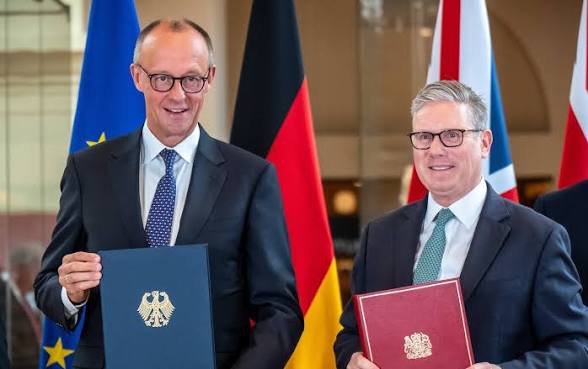
UK, Germany ratify defence treaty amid Russian threat
The United Kingdom and Germany have ratified a defence and security treaty aimed at strengthening cooperation against hybrid attacks, including cyber threats, sabotage and disinformation, amid growing concerns over Russia’s activities across Europe.
The British Prime Minister, Andy Burnham, and German Chancellor Friedrich Merz formalised the ratification of the 2025 Kensington Treaty during a meeting in Berlin, Germany, where both leaders pledged to deepen security cooperation and strengthen economic ties.
Speaking at the German Federal Chancellery, Burnham said the two countries faced hybrid attacks regularly and needed to work together to address the threats.
He said the agreement would improve security across Europe while creating opportunities to boost economic growth and living standards in both countries.
Burnham described the treaty as the first of its kind between the UK and Germany since the Second World War, adding that its implementation marked a significant development in bilateral relations.
The British leader also disclosed that his government would seek to advance discussions on Germany joining the Global Combat Air Programme, a multinational initiative involving the UK, Italy and Japan to develop a next-generation fighter aircraft.
He said the partnership would extend beyond conventional military cooperation to include efforts to counter hybrid attacks, protect democratic processes and strengthen collaboration in quantum technology and space.
Burnham also expressed his intention to host the first joint meeting of the British and German cabinets in 2027.
The Berlin meeting came amid heightened concerns among European governments over alleged Russian involvement in activities targeting critical infrastructure.
Germany accused Russia last month of launching a drone fitted with explosives at Leipzig/Halle Airport, a major international freight hub that also serves as a logistics centre for support to Ukraine.
The British government subsequently summoned a senior Russian diplomat over what it described as an egregious and reckless attack, while the European Union’s foreign affairs chief also summoned Russia’s envoy in Brussels.
Moscow has denied involvement in the incident.
Hybrid warfare refers to activities that fall between conventional armed conflict and peacetime relations. Such operations may involve cyberattacks, sabotage, espionage, disinformation campaigns and attempts to disrupt critical infrastructure.
Former British national security adviser, Sir Mark Lyall Grant, said Russia had intensified such activities in response to European support for Ukraine following Moscow’s invasion.
Grant warned that undersea cables in the North Sea were among the infrastructure attracting Russian interest, adding that the issue was likely to feature in discussions between the British and German leaders.
Meanwhile, Burnham expressed support for closer relations between Britain and the European Union ahead of a planned UK-EU summit next month.
He said he was committed to securing deeper cooperation with European partners, arguing that closer ties would benefit economic growth and efforts to tackle irregular migration.
French Finance Minister Roland Lescure had also urged Britain to consider returning fully to the European Union in an interview with the BBC.
Merz said Germany would support efforts to bring Britain closer to Europe and the EU.
The renewed discussions come amid reports of political pressure on both leaders at home.
Burnham became British prime minister in July after Sir Keir Starmer was forced out by members of his party, two years after leading Labour to a landslide election victory.
Merz, meanwhile, has faced criticism over his government’s standing and setbacks in regional elections, prompting speculation about his political future.
Despite the domestic challenges, both leaders used the Berlin meeting to reaffirm their commitment to security cooperation and closer European relations.

www waliya bet et security guide
www waliya bet com bonus guide for Ethiopian players
www waliya bet com – Full Ethiopian Guide: Registration, Bonuses, Payments, Withdrawals & Mobile

Pastor Jerry Eze Defends Miracles At UK Conference Amidst Criticism And Controversy

Diaspora Watch 20th Edition (October 14-20, 2024): Your Trusted Source for Global News and Insights

Tanzanian Man Reportedly Dies And Returns To Life Six Times


-
 News1 week ago
CARICOM Seeks Renewable Energy Investment to Boost Regional Security
-

 News1 week ago
Climate Change Threatens Global Health as Heat Deaths Rise 36% – Report
-
 Analysis1 week ago
Midterms Vote: The World Watches as America Decides Trump’s Fate
-
News1 week ago
1xbet ml apk – guide complet de sécurité
-
News1 week ago
1xbet app Bangladesh security guide
-

 Analysis1 week ago
On the Killing of Masussuka, by Alabidun Shuaib AbdulRahman