
News
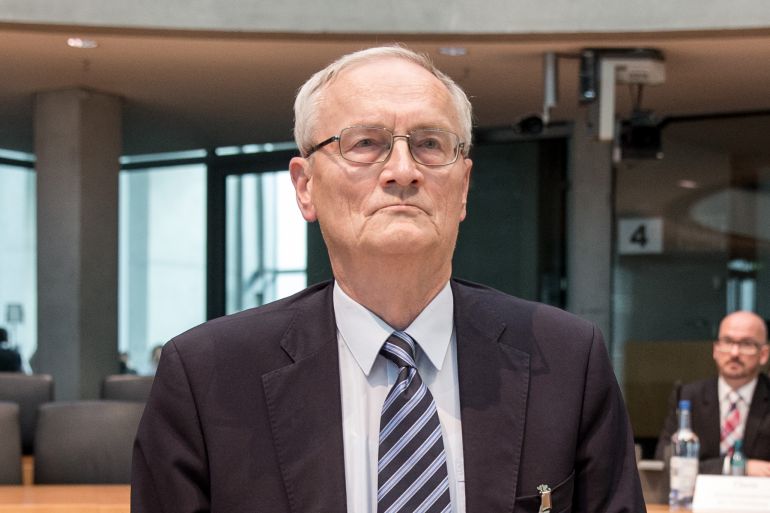
Former German spy chief arrested over alleged espionage

Former German spy chief arrested over alleged espionage
Germany’s former intelligence chief August Hanning has been arrested on suspicion of espionage, treason and obtaining classified information for a foreign power.
Hanning, who headed the Federal Intelligence Service from 1998 to 2005, was arrested alongside former BND employee Manfred D, who prosecutors allege supplied him with about 2,000 classified documents in exchange for money.
Prosecutors said Hanning allegedly used classified intelligence to prepare an analysis for an officer of a foreign intelligence service and maintained contact with another foreign intelligence service.
The authorities have not identified the countries allegedly involved.
Manfred D, who remained with the BND until this year, is accused of accessing highly confidential information through his position and passing it to Hanning.
Hanning is expected to appear in court on Wednesday, while Manfred D is due before a judge on Tuesday.
The case emerged during investigations linked to a separate child-custody case involving German steakhouse heiress Christina Block.


Caribbean states seek stronger regional aviation safety oversight
More than 70 Caribbean aviation stakeholders have called for deeper regional cooperation and pooled technical expertise to strengthen aviation safety oversight across the region.
The call was made on Thursday at a one-day high-level symposium convened by the Caribbean Community Secretariat in collaboration with the International Civil Aviation Organisation and hosted by the Government of Guyana and the Guyana Civil Aviation Authority at the Arthur Chung Convention Centre.
The symposium, which focused on “Strengthening Caribbean Aviation Safety: Regional Cooperation, Resilient Oversight and Sustainable Capacity Development,” brought together ministers responsible for air transport and civil aviation, directors general of civil aviation authorities, government officials, regional institutions, international and development partners, and aviation industry representatives.
Participants said Caribbean states, particularly small administrations, face difficulties maintaining specialised technical expertise and resources needed to meet international aviation safety obligations.
They consequently emphasised the need to strengthen the Caribbean Aviation Safety and Security Oversight System, a CARICOM institution established to assist member states in meeting international standards that may be difficult for individual administrations to sustain.
The participants reviewed the draft CASSOS Roadmap and Action Matrix to 2035, which is expected to address the sustainability of civil aviation authorities, regulatory harmonisation, air transport services under the Multilateral Air Services Agreement, financing, timelines and mechanisms for monitoring implementation.
Strategic partners, including the International Civil Aviation Organisation, European Union Aviation Safety Agency, United States Federal Aviation Administration, Transport Canada and the United Kingdom, also shared perspectives on strengthening regional aviation safety cooperation.
Airlines, private-sector representatives and revenue authorities provided industry perspectives during the discussions.
Speakers at the opening session stressed that Caribbean states have the same international aviation obligations as much larger countries despite operating with smaller populations, markets and technical workforces.
They argued that regional cooperation would enable states to pool expertise and resources while retaining their individual responsibilities under international law.
One of the speakers said, “Our national civil aviation authorities face increasing regulatory demands, technological change, workforce constraints and financial pressures. For small administrations, these realities reinforce a fundamental truth — regional cooperation is indispensable.”
The symposium also noted the importance of aviation connectivity to Caribbean economies, particularly for tourism, trade, investment, emergency response and social integration.
“For small island and low-lying coastal developing states, connectivity is not a convenience, it is a necessity,” another speaker said.
Participants further noted that the Chicago Convention places ultimate responsibility for aviation safety oversight on individual sovereign states, while regional arrangements could strengthen rather than diminish that responsibility.
“Under the Chicago Convention, ultimate responsibility for safety oversight rests with each sovereign State. Yet regional arrangements do not diminish sovereignty; they reinforce it,” a speaker said.
The meeting was also told that effective aviation safety oversight depends not only on regulations and procedures but on the availability of adequately trained personnel with sufficient time and authority to implement them.
The stakeholders are expected to use the discussions to further develop the CASSOS roadmap towards 2035 and establish a more sustainable framework for regional aviation safety oversight.

10-Year-Old Rainikemba Igbokwe Publishes First Book, Small Boy, Big God
A 10-year-old fifth-grade pupil, Rainikemba Igbokwe, has joined the growing community of young authors with the publication of his first book, Small Boy, Big God, a 47-page, 10-chapter inspirational work aimed at encouraging children to dream boldly and use their gifts positively.
The book, published on August 31, 2026, presents a faith-based message centred on the belief that age should not limit a child’s dreams, potential or capacity to make a meaningful contribution to society.
Rainikemba, who is passionate about writing, singing, dancing, playing and worshipping God, is described by his family as a child whose faith and desire to encourage others have shaped his early interest in writing.
In the book, the young author seeks to inspire children to believe in themselves, develop their talents, have faith and, most importantly, find the courage to begin pursuing their dreams regardless of their age.
Speaking about his inspiration, Rainikemba’s outlook is summed up in his simple choice of role model: “God.”
His parents, Mayor Lucky Igbokwe and Divine Maduike Igbokwe, described the publication as a significant milestone in their son’s development, expressing pride in seeing his passion for writing and faith translated into a published book.
For Mayor Lucky Igbokwe, the achievement represents more than the publication of a book.
He said it demonstrates what children can accomplish when their interests are recognised, encouraged and nurtured from an early age.
He said Rainikemba’s achievement should serve as encouragement to parents and families to pay attention to the abilities of their children and provide the support required for those talents to develop.
His mother, Divine Maduike Igbokwe, also expressed pride in her son’s accomplishment, describing the publication as a reflection of his love for God, writing and his desire to encourage other children.
She said the family was particularly encouraged by the message behind Small Boy, Big God, which seeks to remind children that their age does not determine the size of their dreams or the impact they can make.
The 47-page book contains 10 chapters and was published on August 31, 2026, marking what is expected to be the beginning of Rainikemba’s literary journey.
At just 10, the young author has already developed ambitions that extend beyond writing. He hopes to become a teacher, pastor and missionary, while also harbouring the dream of becoming President one day.
Those ambitions, according to his profile, are connected to his desire to teach, serve, inspire and positively influence other people.
Rainikemba’s interests also extend beyond books. He enjoys playing, singing and dancing, while worshipping God remains an important part of his daily life and personal identity.
His decision to identify God as his role model further reflects the central place of faith in his outlook and in the message of his debut publication.
Small Boy, Big God therefore seeks to speak directly to children who may believe that their age makes their dreams too ambitious or their voices too small to matter.
Through the book, Rainikemba encourages young readers to recognise their abilities, believe in themselves and take the first step towards their aspirations.
The publication also comes at a time when conversations around children’s literacy, creativity and early development increasingly emphasise the importance of giving young people opportunities to express themselves beyond the conventional classroom environment.
For Rainikemba, however, the achievement is personal. His first book provides an early expression of what he believes children can become when they are encouraged to dream, create and act on their convictions.
The young author hopes that his work will reach other children and encourage them to discover and use their own gifts.

Trump’s Bomber Pullout: Iran Threat Tests US-UK Security Alliance
By Boniface Ihiasota, Washington DC
The abrupt withdrawal of American B-1 bombers from RAF Fairford in Gloucestershire has transformed what initially appeared to be a routine military movement into a significant security development with wider implications for the United States, Britain and Iran.
President Donald Trump has now confirmed what Washington had initially declined to say publicly: the bombers were moved because of threats against the base.
“They didn’t fly out by accident,” Trump told reporters on Monday as he left the White House for Nebraska. “There were some threats.”
He said the United States knew the people behind the threat and later indicated that they were linked to Iran, although he did not identify the individuals or disclose the precise nature of the intelligence that triggered the withdrawal.
The Pentagon had announced on Sunday that all American bombers deployed to RAF Fairford had returned to their home stations in the United States. About a dozen B-1 aircraft were believed to have been at the Gloucestershire base.
The significance of the decision lies not merely in the aircraft that have left Britain, but in the security calculation behind their removal.
RAF Fairford has for decades served as an important forward operating location for the United States Air Force. In the current conflict with Iran, it became particularly valuable because of its ability to support long-range bomber operations from Europe.
The presence of the B-1s therefore gave Washington a strategically useful platform from which it could project air power towards the Middle East without relying entirely on bases much closer to the conflict.
Their sudden removal suggests that American commanders concluded that the risk of keeping such high-value aircraft at Fairford had become greater than the operational advantage of having them there.
The B-1 is not an aircraft that can simply be replaced by moving a few fighter jets onto another runway. It is a long-range bomber capable of carrying substantial weapons loads and conducting missions over considerable distances. Moving an entire bomber detachment therefore affects the speed and flexibility with which the United States can generate certain strike operations.
Defence analysts have consequently argued that the redeployment reduces Washington’s ability to rapidly surge bomber sorties against Iran, even though it does not remove the United States’ underlying ability to strike from other locations or directly from American territory.
The United States has not abandoned its military posture against Iran. The Pentagon stressed that its bomber force, including B-1s, B-2s and B-52s, remains capable of delivering precision global strikes, including missions launched from the continental United States.
What Washington has surrendered, at least temporarily, is a convenient European launch point. That is where the security incident at Fairford becomes more important.
On September 27, British authorities arrested five men near the base after receiving information about three suspicious vehicles heading towards the facility. A security cordon was established and bomb disposal teams examined the vehicles, while about 85 homes were evacuated as a precaution. The men were subsequently released on bail. A sixth suspect, a 25-year-old British-Iranian national, was later arrested and also released on bail.
No explosives were found in the vehicles, although police reportedly discovered petrol.
British authorities have continued to investigate possible foreign-state involvement. Prime Minister Andy Burnham said there were “strong indications” that Iran had played a part, while Counter Terrorism Policing said investigators were examining all possible lines of inquiry, including possible foreign-state involvement.
Tehran has denied involvement.
That denial is important because, at this stage, the available evidence does not establish publicly that the suspects arrested near Fairford were acting on direct orders from Tehran.
Yet the American concern appears to have gone beyond the arrests themselves.
US media reports have said American intelligence indicated that Iran could have been preparing a drone attack against the base. The reported objective was potentially to damage the expensive bombers and endanger American personnel. The Wall Street Journal reported that the intelligence pointed to a broader Iranian plan targeting the aircraft and US personnel at Fairford.
Neither Washington nor London has publicly released the intelligence behind that assessment. That leaves an important question: what exactly did the Americans believe was about to happen? The answer may lie in the changing character of modern warfare.
The traditional image of an attack on a military airbase involves missiles, aircraft or ground forces. But recent conflicts have demonstrated that relatively inexpensive drones can create vulnerabilities inside heavily protected military environments.
One example repeatedly cited in discussions surrounding the Fairford threat is Ukraine’s Operation Spiderweb in June 2025, when drones were covertly transported into Russia before being launched against military targets. The operation demonstrated how expensive aircraft could potentially be threatened not only by conventional military systems but by relatively cheap unmanned platforms introduced close to their targets.
A bomber sitting on a runway is enormously valuable. A sophisticated air-defence system may protect the perimeter, but it cannot eliminate every possibility of insider assistance, sabotage, covert drone deployment or an attack launched from nearby civilian territory.
That vulnerability becomes more serious when the aircraft are operating from a foreign country. Fairford is in the United Kingdom, not the United States. It is also situated in a populated area. That means Washington’s security calculations inevitably depend on British intelligence, policing and counter-terrorism capabilities.
The recent arrests therefore created a difficult situation for the US and UK. London has maintained that the base is secure. A No 10 spokesman pointed to Trump’s earlier praise for Britain’s police, defence and security services, while Secretary of State Marco Rubio said Washington retained full confidence in the security of its bases and praised British authorities for their cooperation.
But Trump’s comments introduced a different dimension. While Rubio described the movement of American military assets as something that can occur routinely because of rotations, exercises and redeployments, Trump directly linked the bomber movement to threats.
Vice-President JD Vance also described the decision as having been taken out of an “abundance of caution.”
The apparent difference in emphasis may reflect the competing requirements of diplomacy and military security.
Rubio’s formulation avoids publicly confirming intelligence that could reveal how the United States detected the threat or what it knows about its origin. Trump’s statement, meanwhile, communicates deterrence: Washington knows about the threat, knows who it believes is behind it and will not leave valuable military assets exposed simply to demonstrate resolve.
In that sense, moving the bombers can itself be viewed as a security message. It tells Iran, or any actor considering an attack, that the United States can alter its military posture without necessarily escalating immediately.
It also sends another message: American commanders are unwilling to allow a high-value weapons platform to become an easy target for an adversary seeking a symbolic victory.
For Iran, RAF Fairford is especially sensitive because the base has been used to support American military operations in the Middle East. Iranian officials have previously warned that bases used for attacks against Iranian territory could become legitimate targets.
That raises the possibility that the security threat around Fairford is part of a broader contest over the geography of the conflict.
If Iran cannot easily confront American bombers in the skies over the Middle East, it could seek to increase the cost of their deployment by threatening the infrastructure from which they operate.
The United States, however, has several options.
The bombers could be redeployed to American territory, the Gulf region or other overseas facilities, subject to available capacity, allied agreements and security considerations. Analysts have noted that locations such as Diego Garcia could provide alternative operating options, although each carries its own logistical and political complications.


Caribbean states seek stronger regional aviation safety oversight

Will Africa Follow Niger Republic? By Alabidun Shuaib AbdulRahman

The Ondo Air Crash and the Cost of Losing Those Who Protect Nigeria, by Boniface Ihiasota

Pastor Jerry Eze Defends Miracles At UK Conference Amidst Criticism And Controversy

Diaspora Watch 20th Edition (October 14-20, 2024): Your Trusted Source for Global News and Insights

Tanzanian Man Reportedly Dies And Returns To Life Six Times


-
 Diplomacy1 week ago
When Two Powerful Heads Meet …
-

 Politics1 week ago
Lee backs Trump-Kim talks, seeks phased North Korea denuclearisation
-
 News1 week ago
PIF, CARICOM formalise partnership to advance SIDS priorities
-

 Politics1 week ago
Russia may launch limited NATO attack in months, Danish intelligence warns
-
 Analysis1 week ago
Ortom’s 23 Vehicles and the Dangerous Culture of Public Entitlement, by Boniface Ihiasota
-
 Politics1 week ago
EDITORIAL: African Leaders Must Speak to the World With Sovereign Power