
Views
Why Do I Love Nigeria? Let The Whole World Listen!

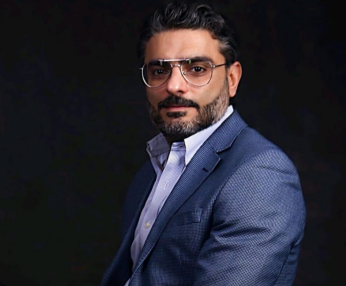
First, name a country where meetings start and end with a prayer. I am not sure there are many, but Nigerians do this. As an expatriate living here, I’ve embraced this tradition and work to reinforce it.
Secondly, I have never seen people as joyful as Nigerians. Even the poorest, without a kobo in their pocket, smile, laugh. Where does this joy come from? It must be a gift from God.
Where else can you visit your brother, sister, uncle, or cousin without needing to schedule an appointment weeks in advance? In Nigeria, family doors are always open, and the soup is ready to be shared. Even when it’s barely enough, you will still get your portion.
Name a place where the elderly are deeply respected. I’ll tell you—it’s Yoruba land. Also, if you want to find a place where people are known to be highly business oriented. That’s Igbo land. Name a place filled with brave, generous people with strong hearts. That’s Hausa land. And if you’re looking for classy, proud Nigerians, visit Edo State, home to the ancient Benin Empire.
Are you curious why I learned Yoruba? I had a teacher come to my office daily to teach me because they have greetings for everything! They love to greet, they are joyful people, and highly educated. I also learned Hausa through a teacher, as it shares words with Arabic and is spoken widely, not just in Nigeria.
Read also : U.S. Government Expresses Gratitude to Nigeria for Tigran Gambaryan’s Release
Nigeria is a blessed nation. Despite the global economic crises, It is striving to rise above them. Yes, there have been challenges and mistakes along the way, and things could have been done better. Nothing good comes easy. There’s still much work to be done.
I love this country and the whole World has to know why. Written by Jimmy Khoury, an expatriate that has lived and worked in Nigeria for 12 years










The Agony of a Columnist, by Alabidun Shuaib AbdulRahman
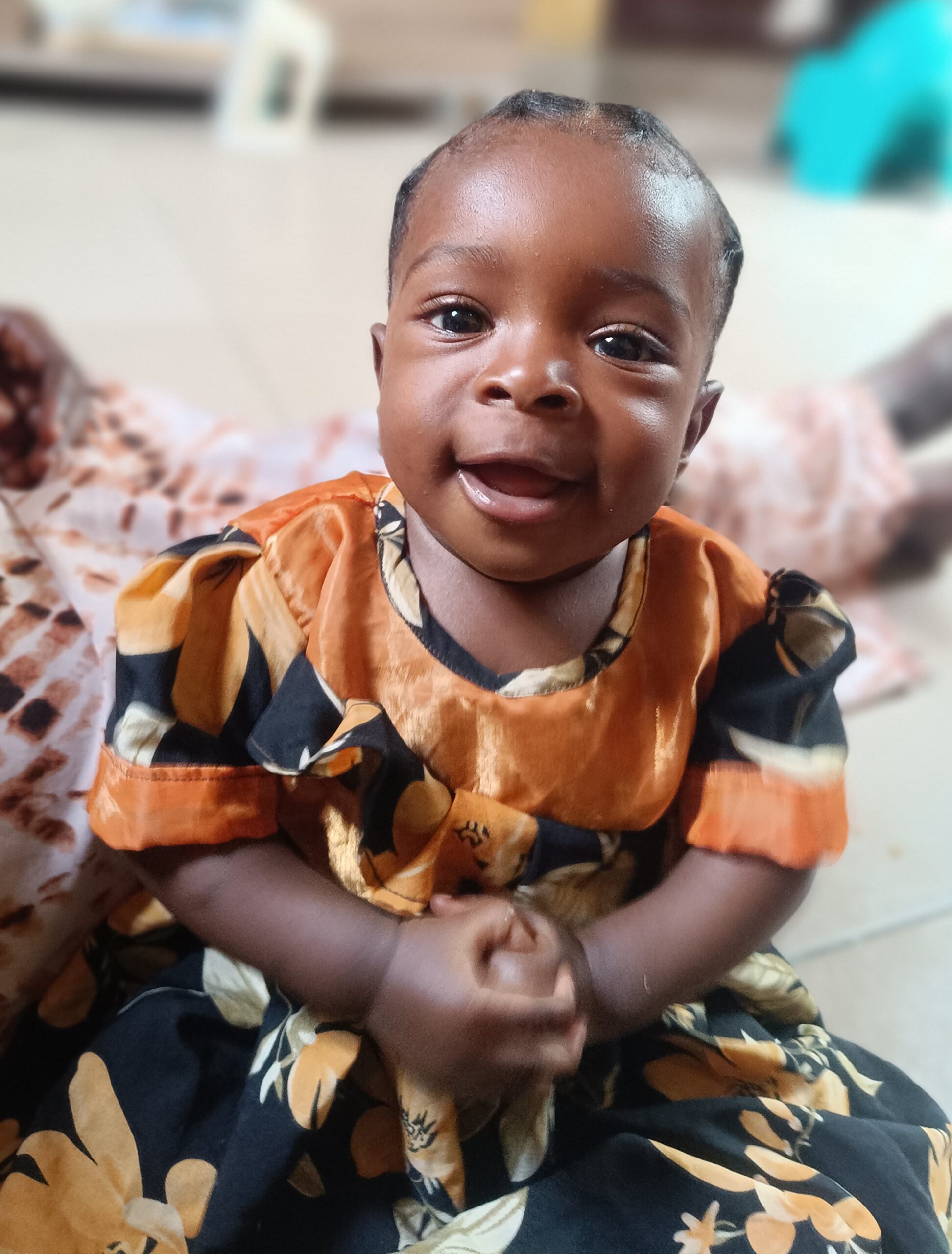
There are pains that refuse to be edited out of memory. No matter how carefully one chooses words, some experiences bleed through the page, heavy and unyielding. I write this not merely as a columnist accustomed to weighing public issues, but as a father whose pen now trembles under the weight of a personal loss that should never have happened.
The death of my eight-month-old daughter, Alabidun Rahmah AbdulRahman, is not just a private tragedy; it is a mirror held up to a system that looks impressive on the surface but collapses at the moment it is most needed.
On Friday, 23rd January 2026, my daughter was taken to General Hospital Suleja because she was unable to suck breast properly. It did not appear, at first, to be a death sentence. Like many parents, I trusted the judgment of trained professionals. The hospital itself inspired confidence. It is well renovated, neatly structured, and visually reassuring. From the outside, it looks like what a modern government hospital should look like. That appearance, in truth, persuaded me to use it. I believed, as any reasonable citizen would, that a facility that looks ready must surely be ready.
That belief became my greatest regret.
Rahmah was admitted the same day on the claim that her condition required emergency attention. She was taken into the Emergency Pediatric Unit, a designation that suggests urgency, speed, and competence. But what followed was neither urgent nor competent. For over thirteen hours, my daughter lay there in visible discomfort, struggling, crying faintly, weakening by the minute.
During this entire period, no doctor came to see her. The only available doctor was contacted several times by a Nurse. Calls were made. Messages were sent. Appeals were raised. Yet she never showed up, never examined the child, never intervened until she passed away Saturday night.
It is difficult to explain what it feels like to watch a child suffer while help remains just out of reach. Hospitals are supposed to be sanctuaries of hope, places where time matters and minutes are counted with seriousness. But in that Emergency Pediatric Unit in Suleja General Hospital, time became an enemy. Thirteen hours passed like a slow execution.
At some point, sensing danger, I requested that my daughter be transferred to a private hospital. I was ready to bear any cost. That request was not granted. Instead, oxygen was administered, as though oxygen alone could replace diagnosis, treatment, and medical presence. Oxygen became a gesture, not a solution. Sadly, when Rahmah took her last breath, it was not because her condition was incurable. It was because care was absent.
This is where the agony deepens. This was not a dilapidated structure abandoned by government. This was a renovated hospital, one that fits neatly into budget speeches and commissioning photographs. Niger State, since 2023, has consistently announced significant allocations to the health sector. In the 2024 fiscal year, over forty billion naira was earmarked for health, with emphasis on improving facilities, upgrading hospitals, and strengthening service delivery.
In 2025 and into the proposed 2026 budget, health allocations rose even higher, approaching over seventy billion naira, according to official budget presentations. These figures are not rumours; they are public records. They are read aloud in legislative chambers and celebrated in press releases. Yet, standing beside my dying child, those billions meant nothing.
A hospital is not healed by paint, tiles, and glass alone. A renovated building without doctors is like a body without a pulse. General Hospital Suleja may look functional, but inside, it suffers from a shortage that is far more dangerous than cracked walls. The absence of medical personnel, especially during emergencies, is a silent killer. No amount of renovation compensates for a system where doctors can choose not to respond to repeated calls when the needs arise.
Also strangely to me, there is the issue of power. What kind of hospital functions with generator power for barely three hours a day, typically between 8pm and 11pm? In a medical environment, power is not a convenience; it is life itself. Equipment depends on it. Monitoring depends on it. Emergency response depends on it. When power becomes a luxury, care becomes compromised. It is disturbing that in 2026, parents still have to pray for electricity in a government hospital while budgets worth billions are announced yearly.
What hurts most is not just the loss, but the realization that this suffering was avoidable. It was not fate. It was negligence. It was indifference. It was a system that has mastered the art of looking prepared while remaining dangerously hollow.
As a columnist, I have written about governance failures, policy gaps, and institutional decay. I have used statistics and official statements to interrogate power. But nothing prepares you for the moment when those abstract failures become personal. When the child you named, carried, and loved becomes a casualty of the same system you once critiqued from a distance.
I cannot, in good conscience, advise even my enemy to use that hospital again, not because it looks bad, but because looks deceive. The pain of trusting a fine exterior only to encounter fatal emptiness inside is something I would not wish on anyone. Health facilities should not be deceptive showpieces. They should be living systems, staffed, powered, responsive, and humane.
This is not a call for sympathy. It is a demand for honesty. If governments will continue to announce impressive budgets, then citizens deserve impressive outcomes. If hospitals are renovated, they must also be manned. If emergency units exist, they must function as emergencies, not waiting rooms for death. Accountability must move beyond paperwork and reach the ward, the night shift, the unanswered phone call.
Alabidun Rahmah AbdulRahman was eight months old. She was my only daughter. She deserved more than silence, more than delay, more than oxygen without care. She deserved a doctor who would show up.
Some losses change a man forever. This one has changed my writing. The pen is no longer just a tool of commentary; it is now an instrument of mourning and witness. If this column unsettles those who read it, then perhaps it is doing what hospitals like General Hospital Suleja failed to do that day — respond with urgency.
For my daughter, and for every child whose life depends on more than painted walls and budget speeches, this agony must be written, remembered, and acted upon.

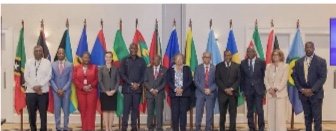
The Twenty-Eighth Meeting of the Council for Foreign and Community Relations (COFCOR) of the Caribbean Community (CARICOM) took place in Basseterre, Federation of Saint Kitts and Nevis, from May 8 to 9, 2025.
The meeting was chaired by the Right Honourable Dr. Denzil Douglas, Minister of Foreign Affairs, International Trade, Industry, Commerce and Consumer Affairs, Economic Development and Investment of Saint Kitts and Nevis.
During the meeting, Foreign Ministers received a presentation on the development of a CARICOM Enlargement Policy, emphasizing the importance of aligning expansion with the Community’s founding principles and priorities.
They also considered the Report of the Technical Working Group Considering the Dominican Republic’s Application for Associate Membership in CARICOM and an update on the status of Bermuda’s Request for Full Membership of the Caribbean Community.
Ministers emphasized the need for increased CARICOM representation in international organizations, endorsing several candidatures to the United Nations, Organization of American States, and other regional bodies.
They noted progress in strengthening relations with traditional partners and expanding outreach to non-traditional partners, welcoming opportunities for strategic partnerships with countries like Canada.
The COFCOR expressed deep concern about the worsening security crisis in Haiti, calling for greater international attention and support, including humanitarian relief and long-term aid.
Ministers reaffirmed the importance of the Community’s Good Offices role through the efforts of the Eminent Persons Group (EPG) in engaging with key Haitian stakeholders and supporting peace and stability in Haiti.
Regarding border issues, the COFCOR expressed concern about increased tensions and maritime incursions in the Belize-Guatemala dispute, urging Guatemala to refrain from exacerbating the dispute.
They also reiterated support for the ongoing judicial process in the Guyana-Venezuela controversy, urging Venezuela to comply with the International Court of Justice’s Order.
The meeting included interactions with representatives from Third States, such as Mexico and the Philippines, where Ministers renewed commitment to advancing bilateral relations and explored opportunities to strengthen ties.
The COFCOR also received requests for the Community’s support for candidatures for a non-permanent seat on the United Nations Security Council from Germany, Portugal, and the Philippines.
The Ministers concluded the meeting with appreciation to the Government and people of Saint Kitts and Nevis for their hospitality and excellent arrangements, looking forward to the Twenty-Ninth Meeting of COFCOR in May 2026.
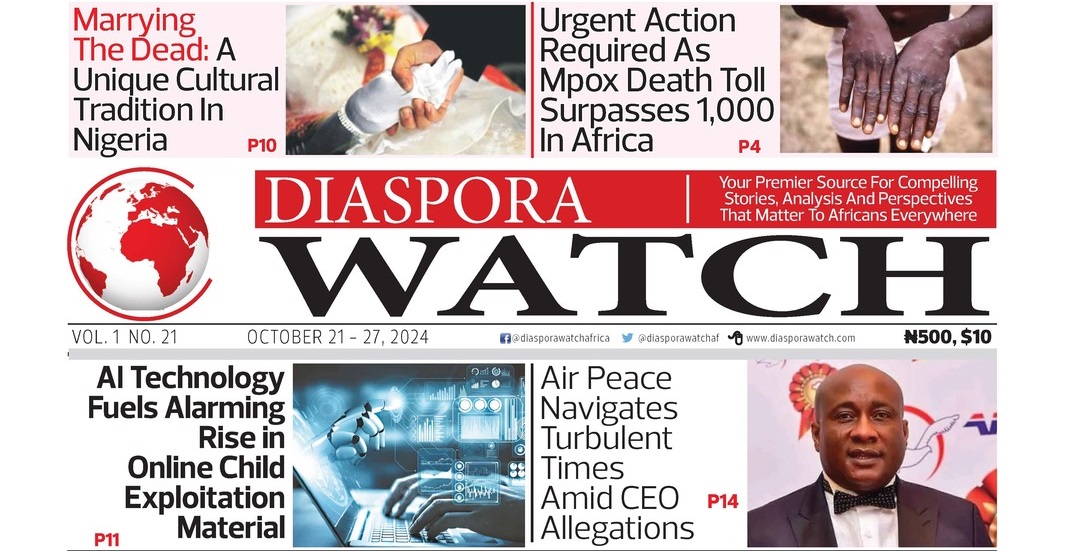
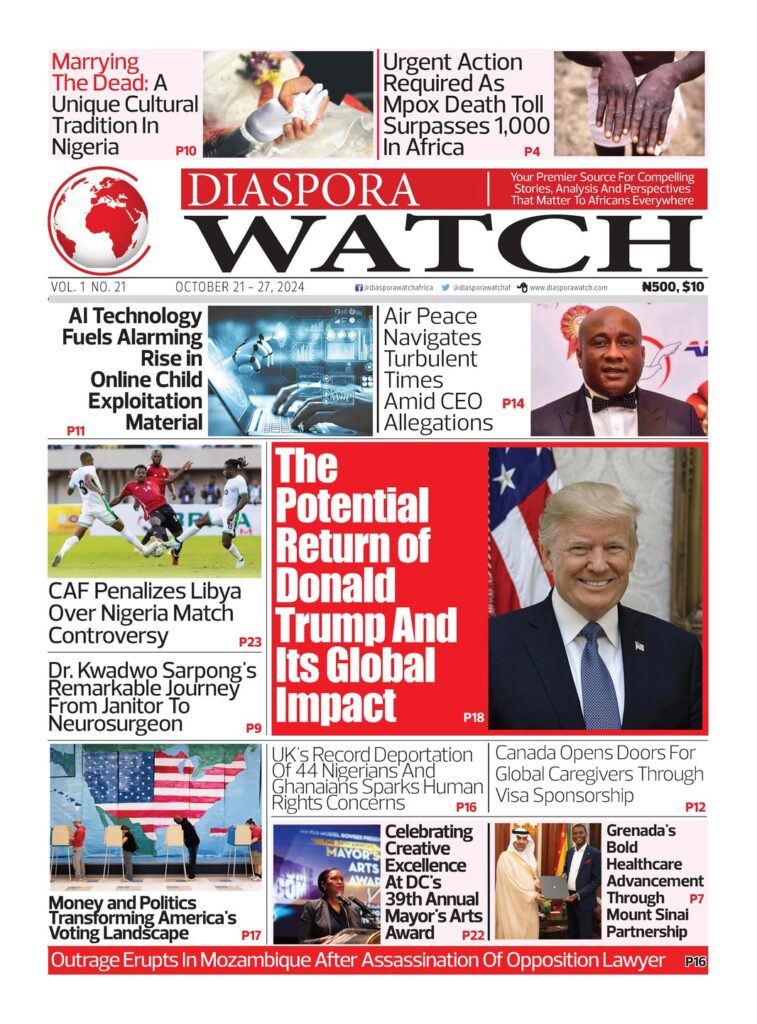
We are excited to announce the release of the 21st edition of Diaspora Watch, your go-to platform for insightful analysis and captivating stories from around the globe, dedicated to uniting African diaspora communities.
FREE Digital View: https://www.flipsnack.com/excelglobalmedia/diaspora-watch-oct-21-27-2024-vol-21/full-view.html
Print on Demand: https://www.magcloud.com/browse/issue/2926055?__r=1069759
SUBSCRIBE TO DIASPORA WATCH NOW ON THE BELOW LINK !!!
https://diasporawatch.com/subscribe-to-diaspora-watch-newspaper/
This issue dives into the heated U.S. presidential race, where Former President Donald Trump and Democratic contender Kamala Harris are making their final appeals to voters ahead of the November 5th election. With reports of vote-buying and significant campaign donations surfacing, we explore the potential implications for American democracy.
On the international front, tensions rise as the Russia-Ukraine conflict escalates, and North Korea aligns itself with Russian interests. In the Middle East, unrest persists following the assassination of a Hezbollah leader, with urgent calls for restraint as fears grow over a possible Israeli invasion of Iran.
In a thought-provoking piece, writer Tony Okoroji examines the possible global repercussions of another Trump presidency. Human rights advocates are also sounding alarms over the UK’s recent deportation of 44 Nigerians and Ghanaians, stressing the urgent need for more humane immigration policies.
The Mpox pandemic remains a serious threat in Africa, with over a thousand fatalities reported in recent weeks. We also delve into a unique Nigerian tradition, revealing how grooms may be compelled to fulfill marital rites under tragic circumstances.
On a lighter note, Washington D.C. recently celebrated creative excellence at the Annual Mayor’s Arts Award, while the Confederation of African Football has penalized Libya for its unacceptable treatment of Nigeria’s Super Eagles during a recent match.
Don’t miss our new Diaspora Connect page, designed to inform young Africans about international opportunities. Plus, be sure to check out the dazzling Didi Nkanta on our Diva Page, adding a touch of glamour to this packed edition.
Grab your copy today for a comprehensive view of our world, and join us as we strengthen the bonds within the African diaspora!


Lee backs Trump-Kim talks, seeks phased North Korea denuclearisation

Russia may launch limited NATO attack in months, Danish intelligence warns

EDITORIAL: African Leaders Must Speak to the World With Sovereign Power

Pastor Jerry Eze Defends Miracles At UK Conference Amidst Criticism And Controversy

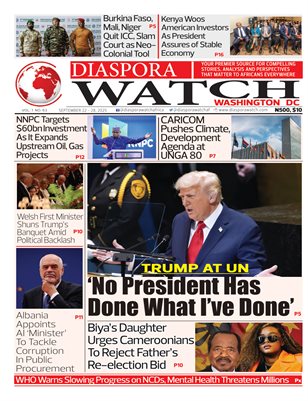
Diaspora Watch 20th Edition (October 14-20, 2024): Your Trusted Source for Global News and Insights

Tanzanian Man Reportedly Dies And Returns To Life Six Times


-
 Diplomacy2 days ago
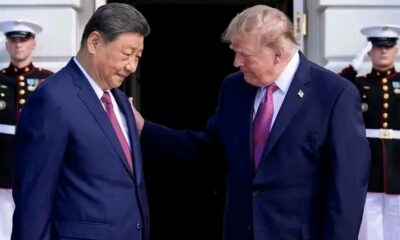
When Two Powerful Heads Meet …
-
 News2 days ago
PIF, CARICOM formalise partnership to advance SIDS priorities
-
 Analysis2 days ago
Ortom’s 23 Vehicles and the Dangerous Culture of Public Entitlement, by Boniface Ihiasota
-
News3 days ago
WinPlace Casino GB – Welcome Bonuses and Casino Promotions
-
News3 days ago
Goldbet Casino w Polsce – Automaty, gry stołowe i kasyno na żywo
-
News3 days ago
Goldbet Casino w Polsce – Dostępne metody płatności i realizacja transakcji