
Diaspora
The Long American Tradition Of Categorizing Immigrants As Either Good Or Bad


The Long American Tradition Of Categorizing Immigrants As Either Good Or Bad
BY H I D E TA K A H I R O TA
In February, President Donald Trump’s Administration sent 178 Venezuelan migrants to the U.S. military base in Guantanamo Bay, Cuba. This is the latest chapter of the Trump Administration’s crackdown on immigrants, a project that officials have said will focus on those with records of unauthorized entry and violent crimes, or “the worst of the worst,” as Homeland Security Secretary Kristi Noem has put it. Advocates of strict border policing today typically divide noncitizens in the United States into two groups: regular immigrants and irregular (unauthorized) immigrants. Then, they disparage the latter as “illegal aliens” and call for their deportation.
This dichotomous categorization of immigrants is in part rooted in 19th century discourse on foreign-born workers, which divided them into “natural” and “unnatural” immigrants. Then as now, separating immigrants into clean binaries may reflect the ideological debates of the present moment, but seldom does doing so reflect the realities they are facing at that time. In the mid-19th century, some Americans criticized immigrant workers for threatening their employment by working at extremely low wages. U.S. workers’ opposition to immigrant labor became particularly strong during the 1870s and
1880s in response to the growth of
industrial capitalism after the Civil
War. At that time, U.S. workers suffered exploitative labor practices and the decline of wages, while the industrial and commercial elite enjoyed the extreme concentration of wealth. These situations provoked radical labor activism. Many labor leaders viewed immigrants employed by capitalists at low wages as advancing the unequal distribution of wealth and contributing to the impoverishment of U.S. workers.
Organized labor directed its harshest criticism against foreign contract workers, who were believed to be imported by capitalists as strikebreakers. Some employers did import immigrants as strikebreakers directly from Europe, but this practice was relatively rare. Many, if not most, foreign-born workers employed as strikebreakers immigrated to the U.S. on their own and were later hired by employers. Also, imported immigrants were not necessarily unskilled laborers; they included skilled workers, such as window glass workers. Nevertheless, opponents of contract workers claimed that capitalists conducted large scale importations of “ignorant, servile, unskilled, and debased labor,” or “‘pauper labor’ of Europe.”
Negative sentiment against contract laborers led to President Chester A. Arthur signing a bill that became known as the Foran Act on February 26, 1885. The Foran Act, also called the “alien contract labor law,” was named after its sponsor, Martin A. Foran, a former labor leader and a U.S. representative from Ohio. The act prohibited individuals and companies from prepaying, assisting, or encouraging the immigration of contract workers in other words, foreigners immigrating under contracts agreements to work in the United States and its territories. The law soon was amended in 1888 to begin deporting foreign contract workers already in the country.
In 1891, Congress went a step further by integrating these restrictions on contract workers into general immigration law, which administered the entry and removal of all foreigners, except the Chinese, whose immigration was restricted by Chinese exclusion laws. The Immigration Act of 1891 added contract workers to the list of prohibited groups of foreigners, including people likely to become public charges, people with contagious diseases, people with mental illness, and criminals.
Central to arguments in favor of the Foran Act was a view of imported workers as unfree, degraded workers, comparable to enslaved people. Proponents of the Foran Act argued that contract workers were unfree people in that their employers controlled them from the moment of their arrival in the United States. Foran argued that contract workers were “not freemen . . . . they are virtually the slaves of those greedy corporations who bring them here.” Forced into “the struggle for existence” over employment, many Americans would be replaced by “these foreign serfs.”
He thus presented the bill as an antislavery measure to protect American workers from competition with unfree labor imported from abroad. In a nation that abolished chattel slavery just two decades ago after the Civil War, opposition to a type of labor that seemed to resemble slavery was a powerful argument.
Labor leaders also stressed that as unfree people, contract workers did not come to the U.S. voluntarily; instead they were induced to migrate by capitalists. These workers, as Foran claimed, “do not initiate their coming.” Samuel Gompers, the founder of the American Federation of Labor (AFL), advanced the binary between free and unfree immigrants, declaring that he had no objection to immigration, so long as “they come here of their own free will.”
These perceptions of contract workers were built upon the existing racist idea that Chinese immigrants to the United States were “coolies,” or unfree indentured workers. Similar views applied to immigrants from southern and eastern Europe, whom many Americans regarded as poor, uneducated, and inferior. Even though many immigrant workers were imported from Belgium, England, Germany, and Ireland, labor leaders predominantly critiqued Italian and Hungarian immigration, blaming capitalists for importing “as so many cattle, large numbers of degraded, ignorant, brutal Italian and Hungarian laborers.” As the San Francisco Call expressed, the condemnation was soon extended to the importation of “destitute Japanese pauper laborers.”
The criticism of labor importation acquired new phrases by the turn of the 20th century. Opponents of contract workers denounced their immigration induced or assisted by employers an transportation companies working with them as “artificial” or“unnatural” immigration.
The AFL resolved to oppose “all artificially stimulated immigration” and demanded “absolute prohibition of the landing of all contract and assisted emigrants.” In 1901, the congressional Industrial Commission on immigration condemned “the artificial immigration induced by employers for the purpose of breaking labor organizations.” Special immigration inspector Marcus Braun claimed that “we are burdened with a dangerous and most injurious unnatural immigration.”
During the first two decades of the 20th century, the Commissioner-General of Immigration, the head of the federal Bureau of Immigration, constantly used such terms as “artificial,” “unnatural,”and “stimulated” immigration disapproving of the importation of contract workers.The implication was clear that “natural” immigration, or the immigration of free people coming to the U.S. on their own, would be more desirable, and better suited to American life. Indeed, during the making of the alien contract labor law, Foran argued that “the best class of immigrants come” from England, Scotland, Ireland, and Germany, while Italy and Hungary sent contract workers to the United States. By the early 20th century, “unnatural” immigration was more commonly associated with immigration from southern and eastern Europe, Asia, and Mexico.
Herein lies one origin of the binary framework of immigration discourse in the United States today which divides noncitizens into “illegal aliens” and legal immigrants. The critique of contract workers created the ideas of natural and unnatural immigration, so that contract workers, or unnatural immigrants, could be vilified and their exclusion justified through contrast with the opposite category, free and natural immigrants. The debate over imported labor and the implementation of the Foran Act laid some of the discursive foundations for today’s debates by helping create a context in which immigration was discussed in dichotomous terms.
Ultimately, the distinction between natural and unnatural immigration remained murky in practice. Officials used their own discretion to decide what contract or assistance meant, often to the disadvantage of migrant groups they considered undesirable. Most immigrants whom they excluded as contract workers were coming to the United States voluntarily, and even those joining their U.S.-based family members could be labeled as contract workers. The binary categorization served as a tool to vilify some foreigners as unnatural immigrants and justify their exclusion.
Today, the category of the “illegal alien” has similar functions. It stigmatizes Latinx migrants, regardless of their immigration status, and legitimizes radical and inhumane approaches to border policing, while immigration restrictionists use it in expansive ways to inaccurately include lawful asylum seekers.
Regarding the migrants sent to Guantánamo Bay, the Trump Administration has not provided sufficient proof of their status and criminality. But reporting by ProPublica and Texas Tribune indicates that at least some of those sent to Guantanamo Bay had no criminal record at all, and many are, by the Trump Administration’s own declarations “low risk.” In fact, some of the people Guantanamo Bay can not even be labeled as unauthorized immigrants, because they entered the U.S. lawfully.
Categorization has been one of the fundamental problems, and the most unreliable ideas, in U.S. immigration policy. The words, labels, or categories that lawmakers use to describe different immigrant groups shape public support or disapproval. Those labels, however, are often arbitrary and do not match the realities of the groups, to the detriment of the immigrants and the rule of law itself.











BCD Fashion-House

Hawah Kromah, Founder of BCD Fashion House


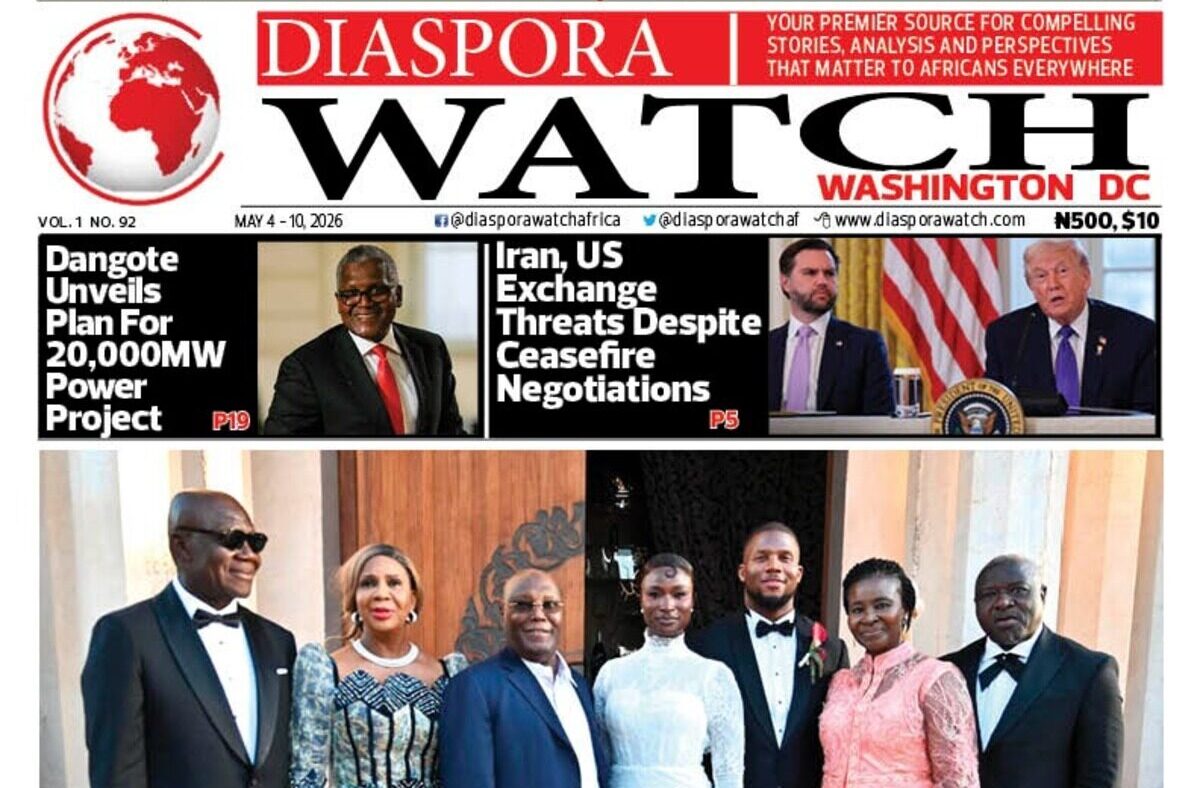
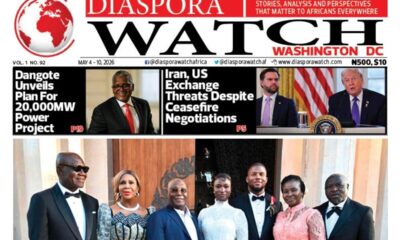
The management of Diaspora Watch Newspaper proudly announces the release of the 92nd edition of the newspaper, a compelling and globally engaging publication that captures the defining political, diplomatic, economic, cultural, and entertainment developments shaping conversations across continents.
This latest edition presents readers with an extraordinary blend of international diplomacy, economic transformation, royal engagements, security concerns, African excellence, and high society glamour, reaffirming Diaspora Watch Newspaper’s commitment to credible journalism, balanced reporting, and insightful global storytelling.
Diaspora Watch FREE Digital View: https://diasporawatch.com/3d-flip-book/diaspora-watch-vol-92/
On Demand Print: https://www.magcloud.com/browse/issue/3327462?__r=1069759
SUBSCRIBE TO DIASPORA WATCH NOW ON THE LINK BELOW!!!
https://diasporawatch.com/subscribe-to-diaspora-watch-newspaper/
Leading the headlines is the intensifying conflict between the United States and Iran as both nations exchange threats despite ongoing ceasefire negotiations, alongside US President Donald Trump rejecting Iran’s peace response and describing the proposal as “totally unacceptable.” The edition also offers deeper insight into the geopolitical implications of the crisis and its potential impact on global stability.
In a celebration of African prestige and international elegance, this edition extensively covers the grand wedding ceremony of Munachi “Muna” Ezeibe and Cherina Zerbo Lassina in Marrakech, Morocco, an event that attracted top African dignitaries, diplomats, business leaders, and influential personalities from across the continent.
Readers will also find exclusive reports on Aliko Dangote’s ambitious 20,000MW power project initiative, a development expected to significantly reshape Africa’s energy landscape and industrial future. Equally noteworthy is the report on Angola’s Cabinda Refinery commencing fuel exports, marking a major milestone in Africa’s refining capacity and economic independence.
The edition further highlights significant global diplomatic and societal developments, including King Charles III hosting the first Buckingham Palace Garden Party of 2026, the accreditation of a new United Kingdom ambassador by CARICOM, and concerns raised by China’s spy agency over the growing “lying flat” culture among young people.
On the back page, readers are treated to dazzling coverage of the 2026 edition of the Africa Magic Viewers’ Choice Awards 2026, where celebrities transformed Lagos into a spectacular runway of glamour, fashion, and unforgettable red-carpet moments.
As always, Diaspora Watch Newspaper remains steadfast in its mission to inform, educate, connect, and amplify global African perspectives through responsible journalism and compelling narratives.
The 92nd edition is now available for readers, stakeholders, institutions, and members of the global diaspora community.
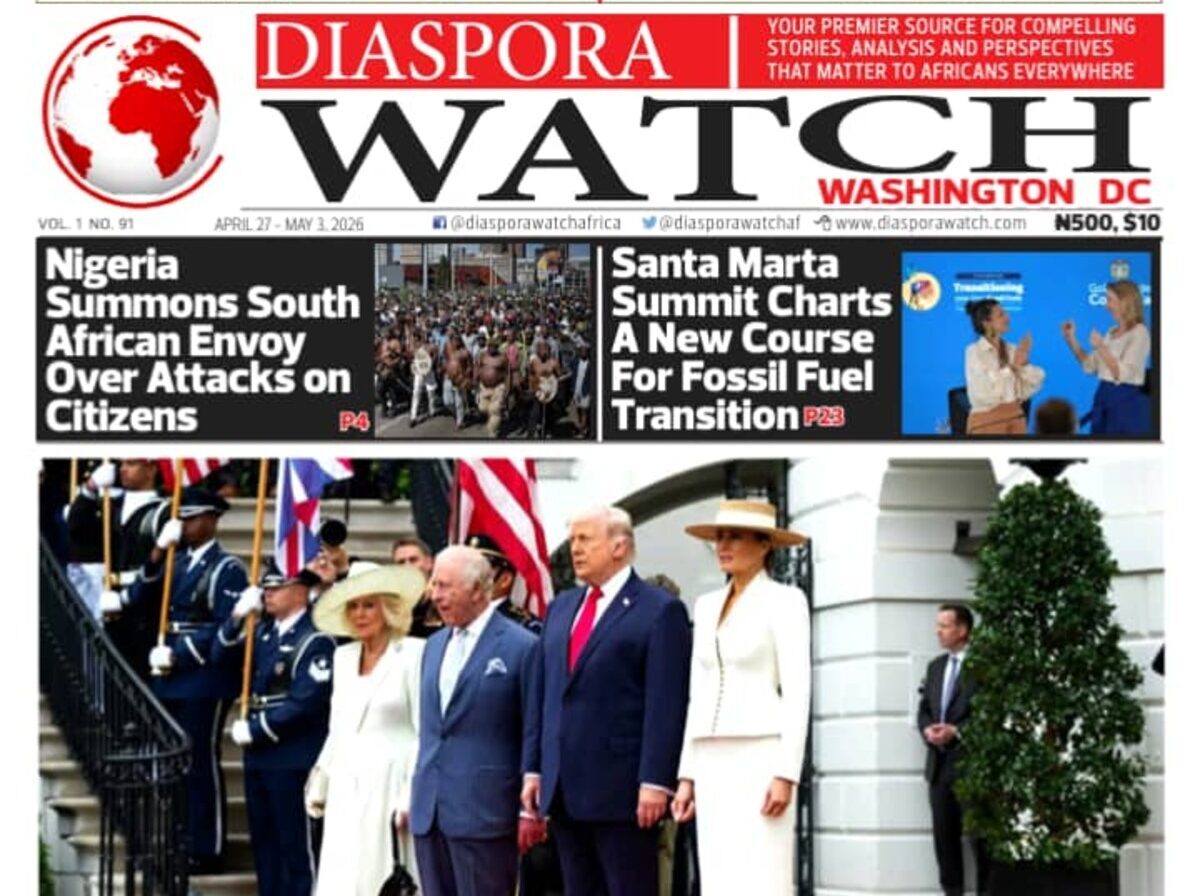
Diaspora Watch Newspaper Releases it’s 91st Edition.
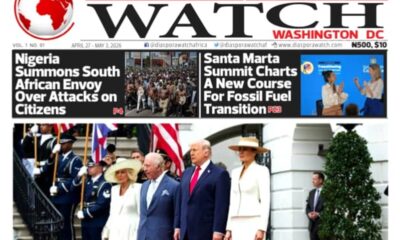
Diaspora Watch Newspaper is proud to announce the release of its 91st edition, delivering a compelling blend of international headlines, geopolitical analysis, and cultural commentary that reflect the dynamic realities shaping the global community.
Diaspora Watch FREE Digital View: https://diasporawatch.com/3d-flip-book/diaspora-watch-vol-91/
On Demand Print: https://www.magcloud.com/browse/issue/3321550?__r=1069759
SUBSCRIBE TO DIASPORA WATCH NOW ON THE LINK BELOW!!!
https://diasporawatch.com/subscribe-to-diaspora-watch-newspaper/
Leading this edition is a major diplomatic spotlight: “Trump Hosts King Charles, Queen Camilla at White House, Hails ‘Unbreakable’ US-UK Ties.” The story examines renewed transatlantic relations and the strategic implications of high-level engagements between the United States and the United Kingdom.
Also featured prominently is Nigeria’s strong diplomatic response to rising tensions in Southern Africa, as the Government summons South Africa’s envoy over reported attacks on its citizens. This development underscores ongoing concerns about the safety and welfare of Nigerians in the diaspora.
In security and defense, the edition reports on the disappearance of two United States troops during military drills in Morocco, raising questions about operational risks and international military cooperation.
On the economic and developmental front, Caribbean leaders take decisive steps toward reducing import dependence through a new food security framework under CARICOM, while the Santa Marta Summit provides fresh momentum for a global transition away from fossil fuels.
Energy discourse is further amplified as the African Petroleum Producers’ Organization advocates for the establishment of regional energy hubs to drive investment in Africa’s oil and gas sector, signaling a strategic shift toward intra-continental collaboration.
In another major geopolitical development, the United States imposes sanctions on former DR Congo President Joseph Kabila over alleged links to the M23 rebel group, reflecting growing international scrutiny over instability in Central Africa.
Meanwhile, tensions in the Middle East deepen as the United Arab Emirates issues a stern warning on Iran’s reliability in managing the Strait of Hormuz, highlighting concerns over global energy security amid escalating US–Tehran relations.
Rounding off the edition on the back page is a cultural reflection from global music icon Jay-Z, who emphasizes authenticity in hip-hop culture with the thought-provoking stance: “Hip-Hop Must Stay Real, Not Trendy.”
Stay informed and ahead of the curve with the 91st edition of Diaspora Watch where we the complex dynamics shaping our world and provide insights into the stories that matter.


CARICOM must impact citizens’ lives, says incoming Chair Pierre

Marketers Import Dangote-Refined Fuel Through Togo Hub

Ghana eyes local takeover of Gold Fields’ Tarkwa mine

Pastor Jerry Eze Defends Miracles At UK Conference Amidst Criticism And Controversy

Diaspora Watch 20th Edition (October 14-20, 2024): Your Trusted Source for Global News and Insights

Tanzanian Man Reportedly Dies And Returns To Life Six Times


-

 Tech1 week ago
Elon Musk Becomes World’s First Trillionaire After SpaceX IPO Pricing
-

 Diplomacy1 week ago
Trade Disruptions, Inflation Threaten Caribbean Growth — Barnett
-

 Analysis1 week ago
An Open Letter to VDM and the Generation That Could Change Nigeria
-

 News1 week ago
Russia Restricts Putin Surveillance Over AI Fears
-
 Features1 week ago
Diaspora Watch Vol. 96
-

 Analysis1 week ago
Nigeria’s Democracy and the Aluta Continua, by Alabidun Shuaib AbdulRahman