
Oil and Gas
U.S. Oil Industry Bleeds Jobs, Cuts Spending as Prices Slide


U.S. Oil Industry Bleeds Jobs, Cuts Spending as Prices Slide
The United States oil sector is facing mounting pressure as falling crude prices, industry consolidation and sweeping cost cuts threaten to end the rapid production growth that had elevated the country to the world’s top producer.
Thousands of workers have been laid off while companies slash billions of dollars in capital spending, fuelling fears that U.S. output may plateau or even decline — a shift that could erode Washington’s influence in global energy markets and complicate President Donald Trump’s energy dominance agenda.
On Sunday, the Organization of the Petroleum Exporting Countries and its allies (OPEC+), announced plans to increase production by 137,000 barrels per day beginning in October.
Analysts view the move as part of the cartel’s strategy to claw back market share lost to U.S. shale producers in recent years.
The production hike has further pressured global oil benchmarks, with prices sliding nearly 12 per cent this year.
U.S. West Texas Intermediate (WTI) futures traded at $62.15 per barrel on Monday — a level close to breakeven for many American producers.
Experts say drilling activity is unlikely to recover unless prices stabilise between $70 and $75 per barrel.
Industry leaders have warned that the financial squeeze is taking a toll. ConocoPhillips, the country’s third-largest oil producer, said it would cut up to 25 per cent of its workforce.
Chevron also announced plans to lay off about 8,000 employees, representing 20 per cent of its global staff.
Oilfield service giants SLB and Halliburton have similarly reduced headcount.
A Reuters analysis found that 22 publicly listed U.S. oil producers — including Occidental Petroleum, ConocoPhillips, and Diamondback Energy — have collectively trimmed capital expenditure by $2 billion this year.
Major players such as ExxonMobil and Chevron were not included in the study but are also expected to scale back investments.
The rig count, a key barometer of drilling activity, has dropped by 69 so far this year, bringing the total to 414, according to data from Baker Hughes.
The decline signals further pressure on future output levels.
As of late August, crude production from the lower 48 states stood at about 13.4 million barrels per day, marginally below the record 13.6 million barrels per day achieved in December 2024.
Analysts caution that if current trends persist, the U.S. could struggle to maintain its status as a swing producer, leaving OPEC+ with more leverage in shaping global oil supply and prices.

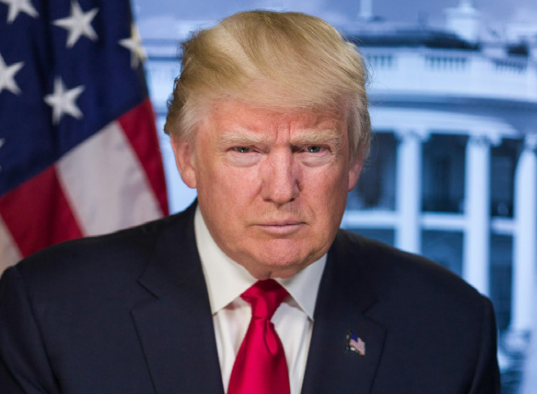
Trump’s fuel price cuts face hurdles ahead of midterm elections
United States President Donald Trump is facing mounting pressure to reduce petrol and diesel prices ahead of the November midterm elections, as rising energy costs continue to weigh on households and businesses.
Trump has announced several measures aimed at easing the burden on consumers, including temporary tax relief on red-dyed diesel used for off-road purposes and efforts to encourage the release of oil reserves.
However, analysts say the measures may offer only limited relief, with the disruption of global energy supplies caused by the conflict involving the United States, Israel and Iran continuing to drive up prices.
The rising cost of fuel has become a major political concern for the Trump administration, with voters increasingly worried about the cost of transportation, food and other essential goods.
Polls indicate widespread dissatisfaction with Trump’s handling of the economy and the war in Iran, putting Republican candidates under pressure ahead of the November elections.
Global oil supplies have been disrupted by the conflict, which has severely affected the movement of crude oil and refined petroleum products through the Strait of Hormuz.
Although crude oil flows have approached pre-war levels, prices remain above $100 per barrel, contributing to higher petrol and diesel costs.
David Ruisard, pricing manager at commodities intelligence firm Argus, attributed the increase in diesel prices to the Middle East conflict and Russia’s ongoing war with Ukraine.
He estimated that about 60 per cent of the increase in diesel prices from approximately $3 to $6 per gallon was connected to disruptions around the Strait of Hormuz, while the Russia-Ukraine conflict accounted for the remaining 40 per cent.
Oxford Economics’ chief US economist, Michael Pearce, said higher energy costs had contributed significantly to inflation this year, putting additional pressure on households and businesses.
He explained that rising energy prices and interest rates were squeezing household budgets while increasing operating costs for businesses.
However, Patrick De Haan, head of petroleum analysis at fuel price tracking website GasBuddy, said petrol and diesel prices had recorded modest declines in recent days, partly due to measures introduced by the Trump administration.
One of the measures announced by Trump allows red-dyed diesel, which is normally reserved for off-road use and is exempt from federal highway fuel taxes, to be used on public roads without the usual federal levies during the temporary relief period.
Ruisard, however, warned that the measure could create complications for trucking companies once the relief expires.
He explained that the red dye was difficult to remove from fuel tanks and that businesses found using the dyed fuel after the exemption ended could face substantial penalties for tax evasion.
He also warned that increased consumption could deplete supplies normally reserved for agricultural machinery, rail operators and other off-road users.
Riyadh Airport Attacks Threaten Oil, Global Trade
By Alabidun Shuaib AbdulRahman, Nigeria
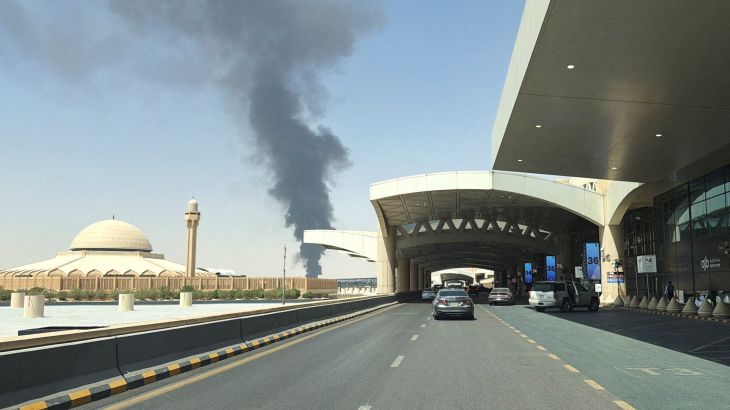
The repeated attacks on Saudi Arabia’s King Khalid International Airport in Riyadh have escalated a regional security crisis with potentially far-reaching consequences for global oil supplies, international trade, aviation, investment and economic stability. With at least 12 people killed and more than 300 injured in Saturday’s attack, followed by another reported strike on Sunday, October 11, the unfolding crisis has placed one of the world’s most strategically important energy-producing countries under renewed pressure.
The immediate concern is the safety of civilians and the protection of critical infrastructure. The broader question, however, is whether the confrontation involving Saudi Arabia and Yemen’s Houthi movement will remain contained or develop into a wider conflict capable of disrupting international commerce and energy supplies.
Saudi authorities reported that the Saturday attack killed 12 people and injured 309 others. The Saudi-led coalition subsequently reported another attack on the airport on Sunday, when an unidentified projectile reportedly struck Terminal 4 and caused a fire. Saudi air defences also intercepted a cruise missile near the airport. The facility’s operations remained suspended following the deadly Saturday attack, according to Reuters reporting on October 11.
The Houthis had warned airlines, passengers and airport workers against using Saudi airports and airspace, describing the area as a potential theatre of military operations. The movement’s warning, coupled with the renewed attacks, has raised concerns about the safety of commercial aviation and the reliability of transport connections across the Gulf.
The attacks come as Saudi Arabia seeks to strengthen its position as a global investment destination, tourism hub and international logistics centre under its Vision 2030 economic diversification programme. The kingdom has invested heavily in infrastructure, entertainment, tourism and other sectors intended to reduce its dependence on oil revenues.
Oil Markets Face Renewed Uncertainty
Saudi Arabia’s importance to the international oil market makes any escalation involving the kingdom a concern for governments, energy companies and consumers worldwide.
According to the United States Energy Information Administration, Saudi Arabia exported approximately seven million barrels of crude oil per day in 2023, accounting for 34 per cent of OPEC’s crude oil exports that year. The agency also reported that Asia received approximately 75 per cent of Saudi Arabia’s crude oil exports, with China, Japan, South Korea and India among its leading customers.
These figures illustrate why instability involving Saudi Arabia can have consequences far beyond the Middle East. Major Asian economies depend on Gulf energy supplies to support electricity generation, transportation, manufacturing and industrial production.
However, an important distinction must be made between an attack on an airport and a disruption to oil production or exports. The reported strikes on King Khalid International Airport do not, by themselves, establish that Saudi oil facilities have been damaged or that crude oil shipments have been interrupted.
The principal economic risk is that the conflict could expand to energy infrastructure, export terminals, pipelines or maritime routes used to transport petroleum.
Such an escalation could cause traders to factor a higher geopolitical risk premium into oil prices. The resulting price movements would depend on the scale of any actual supply disruption, the availability of alternative supplies and the market’s assessment of how long the conflict might last.
The stakes are particularly high because international oil markets are sensitive to disruptions at strategic transportation chokepoints.
The Strait of Hormuz, located between Iran and Oman, is one of the world’s most important oil transit routes. The EIA estimated that approximately 20.9 million barrels per day of petroleum liquids passed through the strait in the first quarter of 2025. Its September 2026 outlook subsequently reported that the volume fell to 4.9 million barrels per day in the second quarter of 2026 amid severe regional constraints.
The figures demonstrate the potential consequences of prolonged instability in the Gulf, although the latest airport attacks should not be confused with the separate developments affecting the Strait of Hormuz.
Any further escalation that threatens oil-producing facilities or maritime transport could intensify uncertainty over supply availability and prices.
For importing countries, the consequences could include higher fuel costs, increased transportation expenses and renewed inflationary pressure. Manufacturers could face more expensive energy inputs, while airlines, shipping companies and agricultural businesses could experience higher operating costs.
Oil-producing countries might benefit from increased export earnings if prices rise, but such gains would depend on their ability to maintain production and deliver crude to international markets.
Red Sea and Bab el-Mandeb: The Trade Connection
The threat to global trade extends beyond aviation because the conflict is unfolding in a region containing some of the world’s most important maritime routes.
The Bab el-Mandeb Strait connects the Gulf of Aden to the Red Sea, providing a gateway towards the Suez Canal and Mediterranean Sea. It is an important passage for commercial shipping between Asia and Europe.
The EIA estimated that approximately 4.2 million barrels per day of crude oil and petroleum products passed through Bab el-Mandeb in the first half of 2025. This represented a substantial decline from 2023 levels amid disruptions to regional shipping.
The same agency estimated that approximately 4.9 million barrels per day of crude oil and petroleum products moved through the Suez Canal and the SUMED pipeline during the first half of 2025.
These figures illustrate the strategic importance of the wider Red Sea corridor to international energy transportation.
If attacks and security threats spread further across the region, shipping companies could face increased insurance premiums, delays, rerouting costs and uncertainty over the safety of vessels and crews.
Ships unable to use the Suez Canal and Red Sea corridor safely may need to travel around the Cape of Good Hope at the southern tip of Africa. Such diversions can increase voyage distances, fuel consumption and delivery times.
The additional expenses may be passed to importers, manufacturers and consumers through higher freight charges and product prices.
For businesses operating with tight delivery schedules, even a temporary disruption can affect inventory management, production planning and contractual obligations. The consequences could be particularly significant for developing economies that rely on imported fuel, machinery, food products and industrial inputs.
African countries are not insulated from such disruptions. Many depend on international shipping to obtain petroleum products, fertilisers, pharmaceuticals, electronics and manufacturing equipment. Higher freight and energy costs can place pressure on their foreign-exchange reserves, trade balances and domestic prices.
Nevertheless, the extent of the impact would vary from country to country according to import dependence, alternative supply routes, exchange-rate conditions and the ability of governments and businesses to absorb higher costs.
The Riyadh airport attacks have not, on their own, established a new disruption to maritime traffic. Their significance lies in the wider security environment in which aviation threats, military operations and risks to regional transport networks are developing simultaneously.
Saudi Arabia’s Economic Ambitions at Risk
The attacks also present a challenge to Saudi Arabia’s economic diversification programme.
Through Vision 2030, the kingdom has sought to develop industries that can generate employment, attract private investment and reduce dependence on petroleum revenues.
Tourism, entertainment, logistics, technology, manufacturing and international events are central to this ambition.
Riyadh’s growing role as a host for international conferences and business gatherings reflects the government’s effort to establish the kingdom as a destination for global commerce.
However, these industries depend on the movement of people, goods and capital. International businesses need reliable transport connections, while tourists and event organisers require confidence that destinations are accessible and reasonably secure.
Political Implications and the Risk of Wider War
The political consequences could prove as significant as the economic effects.
United States President Donald Trump said Washington was considering joining Saudi Arabia’s offensive operations against the Houthis. His comments raise the possibility of a broader American military role in a confrontation that has already placed civilian infrastructure and international transport at risk.
British Defence Secretary Wes Streeting also suggested that the United Kingdom could potentially provide further support to Saudi Arabia.
Neither possibility should be treated as confirmation of a settled decision to participate in offensive military operations. The precise nature of any additional assistance remains important, particularly given the risk of further escalation.
What It Means for Nigeria and Africa
For Nigeria, the developments present both potential economic opportunities and significant risks.
As an oil-producing country, Nigeria could benefit from higher international crude prices through increased export earnings and government revenue, provided production and exports remain stable.
However, higher oil prices do not automatically translate into improved living standards. The domestic impact depends on production volumes, foreign-exchange availability, public expenditure, petroleum product prices and the extent to which additional revenue reaches the wider economy.
If global energy prices rise sharply, Nigerian businesses could face higher transportation, logistics and production costs. These expenses may feed into food prices, manufacturing costs and the prices of goods transported across the country.
The effects could be more difficult for countries that rely heavily on imported petroleum products and have limited fiscal capacity to absorb price shocks.
African governments should therefore monitor developments in international energy markets, review emergency preparedness and strengthen their capacity to manage external economic shocks.

UK Court Hears Recordings in Diezani Bribery Trial
A UK court has heard secretly recorded conversations in which a former Nigerian Minister of Petroleum Resources, Diezani Alison-Madueke, allegedly confronted two oil businessmen accused of bankrolling her luxury lifestyle in exchange for lucrative contracts.
At Southwark Crown Court in London, prosecutors played audio files recovered from a Samsung phone seized during Alison-Madueke’s arrest in 2015.
The recordings, made in 2014, captured conversations between the 65-year-old former minister and oil magnates Olajide Omokore and Kolawole Aluko.
Alison-Madueke denies five counts of accepting bribes and one count of conspiracy to commit bribery.
Prosecutors allege she was provided with “a life of luxury” in the United Kingdom by individuals seeking favourable oil contracts from the Nigerian government during her tenure as petroleum minister between 2010 and 2015.
Omokore and Aluko are not standing trial, but are said to have paid bribes during that period.
In one recording from April 2014, Alison-Madueke was heard confronting Omokore over claims that his wife was spreading information that could implicate her.
“We who are managing the thing have kept quiet… while people like your wife are busy singing all over the place,” she said, adding: “I do not react well to being blackmailed.”
A second recording, made a month later during a meeting with Aluko, captured the former minister criticising what she described as his “lavish, lascivious lifestyle,” warning it was drawing unwanted public attention.
She referenced his associations with high-profile figures, including British supermodel Naomi Campbell, cautioning that such displays were ill-timed.
“As far as everybody’s concerned, you’re a playboy,” she said, warning that intelligence agencies could begin monitoring him because of his conduct and asset acquisitions.
In the audio played to the court, Alison-Madueke expressed anger over suggestions that either man possessed damaging information about her.
“I will be happy to escort all of you to jail along with myself,” she declared. “When it comes to that, I will come out and tell the Nigerian people this is what happened.”
Aluko was heard denying mentioning her name and told the former minister he had placed materials in a safety deposit box that could “save me from jail,” describing himself as flawed but “loyal like a dog.”
Defence counsel previously told the court that Alison-Madueke neither requested nor received financial benefits from the businessmen, noting that they have not been charged or extradited in the matter.
Also standing trial is oil executive Olatimbo Ayinde, 54, who denies one count of bribery relating to Alison-Madueke and another of bribing a foreign public official.
Alison-Madueke’s brother, Doye Agama, 69, a former bishop, also denies a charge of conspiracy to commit bribery.
The trial continues.


CARICOM assesses regional capacity to produce four key products

Trump Rules Out Iran Deal as US Weighs Fresh Military Strikes

Trump’s fuel price cuts face hurdles ahead of midterm elections

Pastor Jerry Eze Defends Miracles At UK Conference Amidst Criticism And Controversy

Diaspora Watch 20th Edition (October 14-20, 2024): Your Trusted Source for Global News and Insights

Tanzanian Man Reportedly Dies And Returns To Life Six Times


-

 Diplomacy2 days ago
UK, Germany ratify defence treaty amid Russian threat
-

 Analysis3 days ago
Africa’s Resources Must Build Africa, by Alabidun Shuaib AbdulRahman
-

 Analysis3 days ago
Nigeria’s 2027 Elections and the Unfinished Business of Diaspora Voting, by Boniface Ihiasota
-

 News3 days ago
Riyadh Airport Attacks Threaten Oil, Global Trade
-
 News2 days ago
Trump Rules Out Iran Deal as US Weighs Fresh Military Strikes
-
 News2 days ago
Trump’s fuel price cuts face hurdles ahead of midterm elections