
News
CARICOM Condemns Escalating Violence, Humanitarian Crisis in Gaza


CARICOM Condemns Escalating Violence, Humanitarian Crisis in Gaza
…Warns against de facto annexation, urges immediate ceasefire
The Council for Foreign and Community Relations (COFCOR) of the Caribbean Community (CARICOM) has expressed deep distress over the worsening violence and humanitarian catastrophe in Gaza, warning that the situation poses grave risks to civilians and threatens long-term peace in the Middle East.
In a statement on recent developments, COFCOR reiterated the concern earlier voiced by the Forty-Ninth Conference of Heads of Government of CARICOM about the “immense, unabated suffering and tragic loss of civilian lives, particularly of women and children.”
The body condemned Israel’s recent decision to seize and maintain control of Gaza City, describing the move as one that could prolong the conflict, worsen the humanitarian crisis, and endanger the lives of Israeli hostages held by Hamas.
It cautioned that such action, which it said could amount to de facto annexation, would deepen famine conditions, deprive Palestinians of basic necessities, and lead to severe malnutrition, starvation, displacement, and death for millions.
COFCOR also raised alarm over reports of targeted killings of journalists and media workers in Israeli strikes, as well as the continued prevention of international media from entering Gaza.
It stressed that such actions hinder independent verification of conditions on the ground and reaffirmed that the bombardment of civilians constitutes a violation of international humanitarian law.
The regional body renewed its call for “an immediate, unconditional, and sustained ceasefire with unimpeded humanitarian access” and urged all parties to prioritise diplomatic efforts towards a durable resolution.
Reaffirming CARICOM’s unwavering commitment to a two-state solution, COFCOR said this remains the only viable path to a “comprehensive, just, and lasting peace” between Israelis and Palestinians.
It pledged solidarity with all victims of the conflict and restated its support for the legitimate aspirations for security and stability of all Israelis, Palestinians, and peoples of the Middle East.

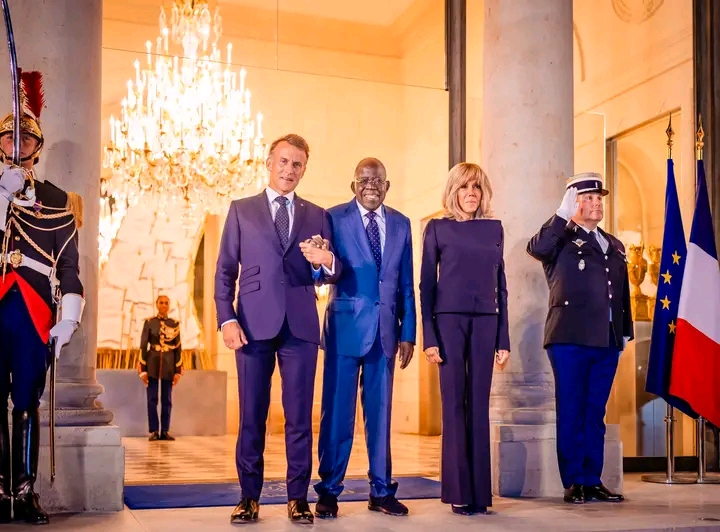
Tinubu In Paris: Macron Dinner, Investment Push, Mambilla Victory
By Alabidun Shuaib AbdulRahman
Nigeria’s President Bola Ahmed Tinubu’s second leg of his three-week European leave in Paris has evolved into more than a stop in the French capital, with high-level diplomatic engagement, renewed investment discussions, digital-economy initiatives and a major arbitration victory for Nigeria converging around the President’s stay.
Tinubu arrived in Paris on Sunday, September 13, after spending the first phase of his annual leave in London. He was received by Nigeria’s Ambassador to France, Ayodele Oke, as the Presidency maintained that the trip was a working vacation ahead of the President’s return to Nigeria.
The Paris leg assumed a distinctly diplomatic character on Thursday, September 17, when French President Emmanuel Macron received Tinubu for a private dinner at the Élysée Palace.
Although details of the private discussions were not released, the Presidency said the encounter reflected the longstanding relationship between Nigeria and France and the two countries’ shared commitment to strengthening bilateral cooperation.
Photographs released from the meeting showed Tinubu with Macron and France’s First Lady, Brigitte Macron.
The engagement was significant against the backdrop of a relationship that has expanded considerably since Tinubu assumed office in May 2023.
France’s Ministry for Europe and Foreign Affairs describes Nigeria as an important partner because of its demographic, economic, cultural and political weight in Africa.
The ministry says bilateral relations have intensified substantially since 2014, particularly in economic and cultural affairs.
France also identifies Nigeria as its largest trading partner in sub-Saharan Africa, accounting for about 20 per cent of France’s trade with the region.
Bilateral trade stood at €5.1bn in 2023, according to French government figures.
The latest Macron-Tinubu engagement therefore came against an established diplomatic framework rather than as an isolated presidential encounter.
Tinubu’s previous major engagement with France included his November 2024 state visit, during which the two countries signed declarations of intent covering economic cooperation, sustainable and solidarity-based investment, critical minerals, banking and the cultural and creative industries.
France also recalls Tinubu’s June 2023 visit to Paris for the Summit for a New Global Financial Pact, his first official foreign trip after assuming office.
But the most tangible economic dimension of the current Paris stay emerged on Friday, September 18, when Tinubu met Vincent Bolloré, chairman of the Bolloré Group, for discussions on expanding the French conglomerate’s investments in Nigeria.
According to the Presidency, the discussions covered film, entertainment, fibre-optic infrastructure and the wider digital economy, with the group indicating plans to deepen the localisation of its operations in Nigeria.
The interests of the Bolloré Group include Canal+, MultiChoice and Universal Music Group, giving the meeting implications beyond conventional infrastructure investment and into Nigeria’s rapidly expanding entertainment, media and technology ecosystem.
For Tinubu, the argument is increasingly centred on converting Nigeria’s enormous cultural influence into domestic economic value.
The President said Nigeria’s global cultural reach through Nollywood, Afrobeats, fashion and other creative industries should translate into greater local production, investment, infrastructure and employment.
The Presidency said the discussions were also linked to the administration’s objective of ensuring that more of the value generated by Nigerian talent remains within the country.
The meeting with Bolloré consequently placed the creative economy alongside digital infrastructure as an emerging component of Nigeria’s investment diplomacy.
It was also consistent with another initiative announced during the Paris period: the movement of Nigeria’s Digital Free Zones programme into its implementation phase.
The initiative is designed to enable Nigerian technology and service companies to raise international capital, serve global markets and retain their businesses and intellectual property in Nigeria rather than relocating abroad.
Tinubu directed the Minister of Trade and Investment, Jumoke Oduwole, who is vice-chairman and implementation coordinator of the Presidential Steering Committee on Digital Free Zones, to work with the committee and Itana Innovation to develop a roadmap for the full launch of the programme within 180 days.
At the centre of the initiative is Itana, described by the Presidency as Nigeria’s first Digital Free Zone and already licensed by the Nigeria Export Processing Zones Authority.
The government said the Africa Finance Corporation is backing the $500m Itana Innovation project at Alaro City in Lagos, where an innovation campus, access to capital and ecosystem services are expected to support African digital businesses.
Tinubu’s pitch is that Nigeria should not merely produce the talent powering the global digital economy while the companies, intellectual property, capital and high-value jobs are domiciled elsewhere.
The President said the administration wanted companies to be incorporated, financed and governed from Nigeria while serving customers across Africa and the wider world.
That economic message ran parallel to an important legal development in Paris.
On Thursday, September 17, an International Chamber of Commerce arbitration tribunal sitting in Paris delivered an award in favour of Nigeria in the long-running dispute involving Sunrise Power and Transmission Company Limited over the Mambilla Hydroelectric Power Project in Taraba State.
The case had exposed Nigeria to claims running into billions of dollars.
Sunrise had sought $680m in one aspect of the dispute while a separate arbitration involved claims exceeding $2.7bn relating to the proposed 3,960-megawatt Mambilla project. The tribunal rejected the claims.
According to details reported from the award, the tribunal also rejected Sunrise’s $400m claim arising from a 2020 settlement agreement and ordered Sunrise and its promoter, Leno Adesanya, to reimburse Nigeria 75 per cent of its legal fees and expenses, amounting to about $11.82m.
The dispute dates back to an agreement connected with the proposed Mambilla project and subsequent arbitration proceedings initiated in 2017.
A 2020 settlement agreement later produced another dispute after the government did not make the agreed payment.
Reacting to the ruling, Tinubu commended Attorney-General and Minister of Justice, Lateef Fagbemi, the Federal Ministry of Justice and the Nigerian defence team led by Elizabeth Oger-Gross and Tolu Obamuroh.
He also acknowledged the testimony of former President Olusegun Obasanjo and the late former President Muhammadu Buhari, as well as former ministers Babatunde Fashola and Suleiman Adamu and other witnesses.
Tinubu described the decision as removing what he called the “single biggest legal hurdle” that had paralysed the Mambilla project for years.
The coincidence of the arbitration ruling with the President’s presence in Paris gave the French leg of his European leave an unusual international dimension, even though the arbitration was a judicial proceeding independent of Tinubu’s presidential engagements.
The Mambilla project itself remains one of Nigeria’s most ambitious proposed power developments.
The planned hydroelectric scheme in Taraba has long been associated with the country’s search for large-scale additions to its electricity generation capacity, but contractual and legal disputes have contributed to its prolonged uncertainty.
The developments in Paris also underline the breadth of Nigeria-France relations.
The relationship now extends beyond traditional diplomacy into investment, banking, critical minerals, culture, entertainment, technology and infrastructure.
French authorities have described Nigeria as an indispensable interlocutor in Africa, while successive Nigerian administrations have sought to leverage French capital and expertise across strategic sectors.
For Tinubu, the Paris stop consequently became a meeting point for several strands of his administration’s international economic diplomacy: attracting foreign capital, keeping Nigerian intellectual property at home, expanding the creative economy, strengthening digital infrastructure and protecting the country’s position in international commercial disputes.
Yet the circumstances surrounding the trip have also attracted domestic political attention.
Tinubu left Abuja on August 30 for a three-week annual leave, with London as his first destination and Paris as the second leg.
The Presidency had described the absence as a working vacation and said the President would return to Nigeria at the end of the period.
The President’s stay abroad also generated debate over the constitutional question of presidential delegation during an extended absence, with some political figures questioning why Vice-President Kashim Shettima had not been formally designated Acting President.
Those arguments were publicly advanced by critics and were separate from the diplomatic and economic engagements in Paris.
For France, however, the immediate story has been the continuation of a relationship that has steadily acquired greater strategic and commercial depth.
While for Nigeria, the Paris episode has produced a cluster of developments that extend well beyond a presidential dinner: renewed contact with the Élysée Palace, an investment conversation with one of France’s most influential business groups, an implementation push for digital free zones and an ICC ruling that rejected multibillion-dollar claims connected to one of the country’s biggest proposed power projects.
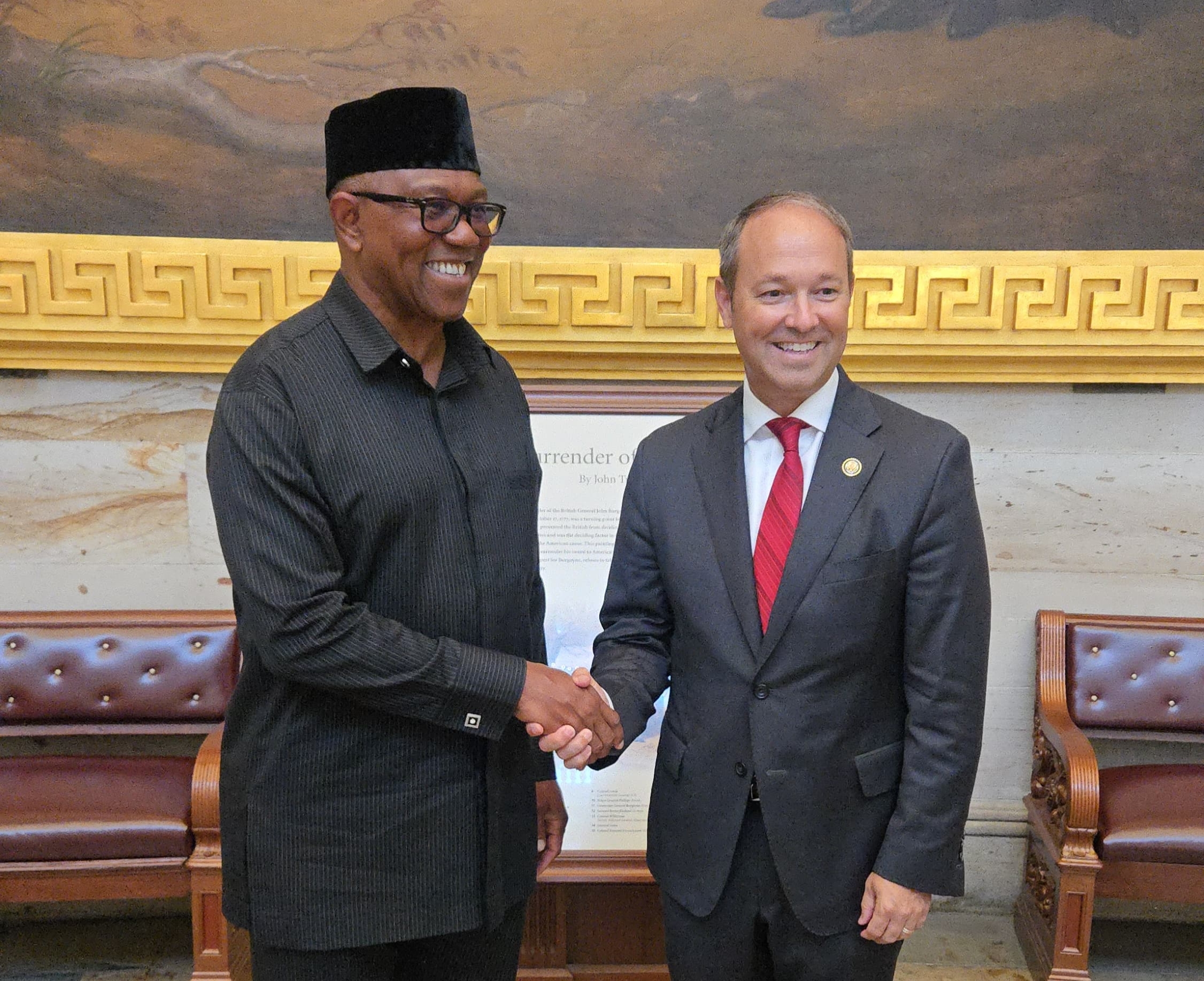
US Congressman Stutzman to Peter Obi: I Sense Trust, Honesty in You
By Boniface Ihiasota, Washington D.C.
Former Anambra State Governor and Nigeria Democratic Congress presidential candidate, Peter Obi, has intensified his engagements with American policymakers and the Nigerian diaspora in Washington, D.C., ahead of the 2027 general elections.
Obi’s latest engagement included a meeting with United States Congressman Marlon Stutzman, who represents Indiana’s 3rd Congressional District, during which discussions reportedly centred on Nigeria’s democracy, the country’s relationship with the United States and the need for credible elections.
Speaking during an interview following the meeting, Stutzman described trust and honesty as essential elements in strengthening relations between the United States and Nigeria, saying he sensed both qualities in Obi.
“The relationship between the United States and Nigeria has to be built on trust and honesty and I sense those qualities with Mr. Obi today,” Stutzman said, according to the interview.
The meeting comes at a time when Nigeria’s political actors have increasingly sought to engage influential groups and policymakers in Washington as the country approaches another presidential election cycle.
Obi has used his engagements in the United States to make a case for stronger democratic institutions, credible elections and greater international attention to Nigeria’s security and governance challenges.
Speaking on the importance of the 2027 election, Obi told his interlocutors that getting Nigeria’s electoral process right would have consequences beyond the country’s borders.
“Getting Nigeria’s election right is as good as fixing Africa’s problems by 75 per cent. Nigeria remains the mirror through which the world sees the rest of Africa,” Obi was quoted as saying.
The former Anambra governor’s Washington engagements have also included meetings with Nigerian professionals and members of the diaspora.
On September 14, 2026, he said he met young Nigerian professionals in Washington, including medical doctors, educators, lawyers, engineers, technology experts, entrepreneurs and business leaders.
Obi said the discussions focused on good governance and reforms, adding that leadership reform was central to Nigeria’s transformation.
The renewed diplomatic and political engagement has also brought the issue of foreign lobbying into the Nigerian political conversation.
In January, Obi criticised reports that about $9m had been committed to foreign lobbying in Washington, describing the reported expenditure as an example of what he considered misplaced priorities.
The $9m figure has featured prominently in subsequent reports on Nigerian political and government-linked lobbying activities in the United States.
The Nigerian Government has, however, defended the broader need for international advocacy and communication.
In February, President Bola Tinubu’s Senior Special Assistant on Foreign Affairs, Ademola Oshodi, argued that Nigeria needed to do more to project its image internationally, saying inadequate communication could have national-security implications.
Against that backdrop, Obi’s decision to undertake direct engagements in Washington rather than relying solely on third-party lobbying has become a notable feature of his current international outreach.
His message has been that Nigeria’s democratic credibility is not only an internal matter but also one with implications for the country’s relations with strategic partners, particularly the United States.
The Washington meeting with Stutzman also places the 2027 electoral process within the wider conversation about Nigeria’s international standing, democratic institutions and security challenges.
For Nigeria’s international partners, the conduct of the 2027 elections is expected to attract considerable attention as political parties and candidates begin positioning themselves for the contest.
Obi, who came third in the 2023 presidential election, has continued to campaign around institutional reform, accountability and leadership, while his recent Washington engagements have expanded that message to American policymakers and Nigerian professionals abroad.
The meeting with Stutzman, therefore, represents another effort by Obi to place Nigeria’s democratic transition and international partnerships at the centre of discussions with influential stakeholders outside the country.
CARICOM Pushes Reparations Agenda, Unveils Revised Ten-Point Plan
The Caribbean Community, CARICOM has renewed its campaign for reparatory justice for the descendants of Africans subjected to trafficking and racialised chattel enslavement, as CARICOM Secretary-General, Dr Carla Barnett, called for stronger diplomatic action, historical recognition and transformative programmes across the region.
Barnett made the call on Thursday, at the opening of the Third CARICOM Regional Conference on Reparations held at the Wyndham Grand Sam Lord’s Castle, St Philip, Barbados.
The three-day conference, which ended on Saturday, was organised under the theme, “Reparatory Justice as the Coming Enlightenment,” and brought together representatives from the Caribbean, Africa, the African diaspora, Indigenous communities, civil society and international organisations.
The conference was convened by the CARICOM Reparations Commission, the Government of Barbados and the CARICOM Secretariat at a significant point in the regional reparations campaign, following the adoption of United Nations General Assembly Resolution A/RES/80/250 on March 25, 2026.
The resolution declared the trafficking of enslaved Africans and the system of racialised chattel enslavement of Africans to constitute “the gravest crime against humanity.” It was adopted by a vote of 123 in favour, three against and 52 abstentions.
Speaking at the conference, Barnett said the Caribbean’s reparations campaign was fundamentally rooted in justice, accountability and transformation.
“The Caribbean has consistently asserted that reparations is fundamentally about justice. It is about recognition, accountability and transformation, and about building a just and equitable future for the descendants of those who, as the chattel of colonial owners, endured untold suffering, loss of life and loss of freedom,” she said.
Barnett said the revised CARICOM Ten-Point Plan for Reparatory Justice, which was adopted by CARICOM Heads of Government in July, provided a broader framework for addressing both historical injustices and their contemporary consequences.
According to her, the plan places emphasis on areas including public health, education, psychological rehabilitation, cultural development, support for Indigenous communities, gender justice, debt cancellation and monetary compensation.
She said the revised document, titled “A Manifesto for the Coming Enlightenment,” reflected progress made in the reparations movement over the past 13 years and sought to advance what she described as a new global order based on equity.
Barnett also commended the CARICOM Reparations Commission, chaired by Professor Sir Hilary Beckles, for its advocacy and intellectual leadership since its establishment in 2013.
She said 12 CARICOM member states had established national reparations commissions or committees, describing the development as evidence of the region’s commitment to coordinated national and regional action.
The CARICOM Secretary-General further pointed to growing collaboration between the Caribbean and Africa, particularly through the African Union.
She recalled the Second Africa-CARICOM Summit of Heads of Government held in Ethiopia in September 2025, where leaders adopted the Addis Ababa Declaration on Transcontinental Partnership in Pursuit of Reparatory Justice for Africans and People of African Descent through Reparations.
Barnett said the declaration had provided an important framework for continued cooperation between the two regions.
She also acknowledged the role of the African Union’s reparatory justice initiative and the leadership of Ghanaian President, John Dramani Mahama, in his capacity as AU Champion for Reparatory Justice.
The Secretary-General said the reparations movement had also benefited from partnerships with United Nations human rights bodies, including the UN Permanent Forum on People of African Descent, the Working Group of Experts on People of African Descent and the Committee on the Elimination of Racial Discrimination.
She said CARICOM expected its Heads of Government to make reparatory justice a significant part of their engagements at the 81st session of the UN General Assembly and at the high-level meeting marking the 25th anniversary of the Durban Declaration and Programme of Action.
She added that CARICOM would seek to advance the issue at the Commonwealth Heads of Government Meeting scheduled to be hosted by Antigua and Barbuda in November.
Barnett, however, stressed that governments could not drive the reparations movement alone.
“The reparations movement has never belonged solely to governments,” she said, noting the contributions of scholars, activists, community leaders, artists, faith-based organisations, youth and citizens.
She also called for greater participation of Indigenous peoples, including the Garifuna, Kalinago and Maroons, saying their history, rights and aspirations should form part of the regional discussions.
The Secretary-General equally urged greater involvement of young people, describing them as the generation that would inherit the opportunities created by the reparations movement.
Barnett said the immediate task was to translate advocacy into sustained diplomatic engagement and use historical research and evidence to inform policies and programmes capable of improving people’s lives.
“This Conference provides an opportunity to reaffirm our principles, renew our commitment to unity and, critically, to strengthen our strategy,” she said.
The conference is the third major regional CARICOM gathering dedicated to reparations and comes amid increased international attention to historical slavery, colonialism and their continuing consequences.
CARICOM had described the 2026 meeting as its first major reparations forum following the March UN resolution.



Are Killings in Niger State Beyond Ordinary? By Alabidun Shuaib AbdulRahman

Tinubu In Paris: Macron Dinner, Investment Push, Mambilla Victory

US Congressman Stutzman to Peter Obi: I Sense Trust, Honesty in You

Pastor Jerry Eze Defends Miracles At UK Conference Amidst Criticism And Controversy

Diaspora Watch 20th Edition (October 14-20, 2024): Your Trusted Source for Global News and Insights

Tanzanian Man Reportedly Dies And Returns To Life Six Times


-

 Analysis7 days ago
The Dark Lessons From Anambra, by Boniface Ihiasota
-
 News7 days ago
98 Nigerians Killed in South Africa Since 2022, Fresh Deaths Deepen Diplomatic Row
-
 Analysis7 days ago
Kaduna’s Security Question, by Alabidun Shuaib AbdulRahman
-
 News7 days ago
CARICOM backs renewal of Haiti gang force mandate
-
 News7 days ago
US, Colombia negotiate tariff deal — Rubio
-
 Politics7 days ago
US seeks roadmap to restart Russia-Ukraine peace talks — Rubio