
Sports
Aso Villa Rolls Out Red Carpet For Nigeria’s First Super Bowl Winner, Moro Ojomo


In a grand ceremony held at the State House in Abuja, President Bola Tinubu welcomed Moro Ojomo, the Nigerian-born American football player who clinched Super Bowl LIX, on Friday. Ojomo, a Philadelphia Eagles player, was accompanied by his family, including his father, Olo-lade; mother, Bimbo; and sister, Modele. The 23-year-old athlete, born in Lagos, arrived in Nigeria on Wednesday, marking his return to his homeland after his family relocated to the United States when he was seven.
Ojomo’s visit comes on the heels of his team’s triumph in the National Football League (NFL) championship, where they defeated the Kansas City Chiefs 40-22. In a statement made upon his arrival in Lagos, Ojomo credited his Nigerian upbringing and passion for the country as the driving force behind his success in the NFL.
“I have a drive and motivation that stem from my upbringing as a Nigerian, and my passion for this country allows me to excel. Nigeria has helped me succeed on the biggest stage,” he said. Ojomo also highlighted the growing presence of Nigerians in American football, emphasizing the opportunities the sport provides.
“It is everything when you look at the number of Africans, specifically Nigerians, in American football. The most important thing is giving our youths an opportunity to get into the sport. It is a pathway to education, high school and college degrees, and a means to put Nigeria on the global stage,” he added.
The Nigerian-born athlete encouraged his compatriots to seize opportunities and believe in their potential. “Just believe you can do anything. I know Nigerians are great, and I believe you should take advantage of opportunities and not let anyone deter you,” he concluded.
During his meeting with President Tinubu, Ojomo presented the President with a customized Philadelphia Eagles jersey, bearing the number 77, his jersey number. The President praised Ojomo’s achievements, saying, “Moro’s success is attributed to the talent and resilience of Nigerian youths. We are proud to have him as a role model and ambassador for our country. “Ojomo’s visit to Nigeria is seen as a significant boost to the country’s sports development, particularly in American football.
Diaspora Watch reports his success in the NFL has inspired many young Nigerians to take up the sport, and his visit is expected to further promote the growth of American football in the country. In addition to his meeting with President Tinubu, Ojomo is also scheduled to visit several schools and sports facilities in Lagos, where he will interact with young athletes and share his experiences with them.
Ojomo’s story is a remarkable one, from his humble beginnings in Lagos to his rise to fame in the NFL. His visit to Nigeria is a celebration of his achievements and a reflection to the power of hard work, determination, and passion.





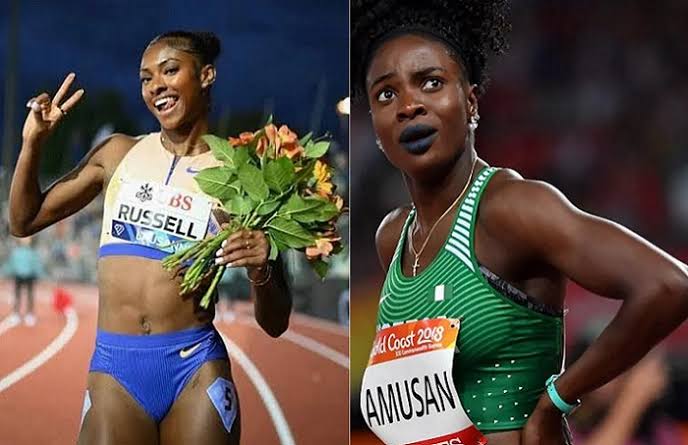
Tobi Amusan’s Legacy After the World Record Falls, by Boniface Ihiasota
There are moments in sport when a stopwatch does more than record time. It records the changing of an era. That was the drama that unfolded in Zurich on Thursday, August 27, 2026, when American Olympic champion Masai Russell ran 12.09 seconds to erase Tobi Amusan’s world record in the women’s 100m hurdles.
For Nigerians watching from home and across the diaspora, it was a moment of conflicting emotions. The green-and-white pride associated with Amusan’s name suddenly had a new number attached to it. Yet, perhaps more importantly, the Zurich race demonstrated that sporting greatness is not diminished simply because a record is eventually broken.
Russell’s 12.09 seconds was extraordinary. She lowered Amusan’s 12.12-second world record by three hundredths of a second, with no assisting wind recorded. Reuters reported that Russell pulled decisively clear after the final hurdle to complete one of the defining performances of the 2026 athletics season.
But the story of Zurich is not simply about an American taking a Nigerian record. It is about two exceptional athletes meeting at different points of their careers and, in doing so, reminding the world why records exist in the first place: to be challenged.
Four years earlier, on July 24, 2022, Amusan had stunned the athletics world at Hayward Field in Eugene, Oregon. She ran 12.12 seconds in the semi-final of the World Athletics Championships, with a legal tailwind of 0.9 metres per second, establishing a new world record. World Athletics subsequently ratified the performance.
That evening transformed Amusan from a brilliant Nigerian hurdler into a global sporting icon. She went on to win the world title, completing a remarkable championship after having endured fourth-place finishes at the 2019 World Championships and the Tokyo 2020 Olympics. Her 12.12 remained the benchmark for four years.
And perhaps that is why her performance in Zurich deserves more attention than the silver medal beside her name. With the world record literally disappearing in front of her, Amusan did not collapse under the weight of history. Instead, she produced her fastest performance of the 2026 season, clocking 12.23 seconds to finish second behind Russell.
Sport has a cruel habit of reducing athletes to medals, rankings and numbers. But behind every record is a human being who has spent years training, sacrificing and competing against limits that most people will never understand. Amusan’s 12.12 was not merely a number on a results sheet. It represented years of Nigerian athletic excellence and a moment when an African woman stood at the summit of one of the world’s most competitive sporting disciplines.
Russell has now inherited that summit. At 12.09, she has also announced something potentially more significant: the possibility that the women’s 100m hurdles may be entering another extraordinary era. Russell had already run 12.14 earlier in 2026, the second-fastest performance in history at the time, before producing the world record in Zurich.
For the Nigerian diaspora, therefore, this should not be remembered as the night Nigeria lost a record. It should be remembered as the night Tobi Amusan’s record became part of athletics history.
Amusan has already changed how young Nigerian athletes see the hurdles. She has shown that an athlete from Ijebu-Ode can rise through international competition and become the fastest woman ever over the 100m hurdles. Her name will remain attached to the record books as the athlete who broke the barrier first.
Russell’s achievement does not erase Amusan’s chapter. It begins a new one. And perhaps the most beautiful part of Zurich was that Amusan was there when history moved forward. She did not merely watch her record fall; she answered with a season’s best.
That is how champions respond when the world changes around them. The record now belongs to Masai Russell. But the legacy of Tobi Amusan remains unmistakably Nigerian.

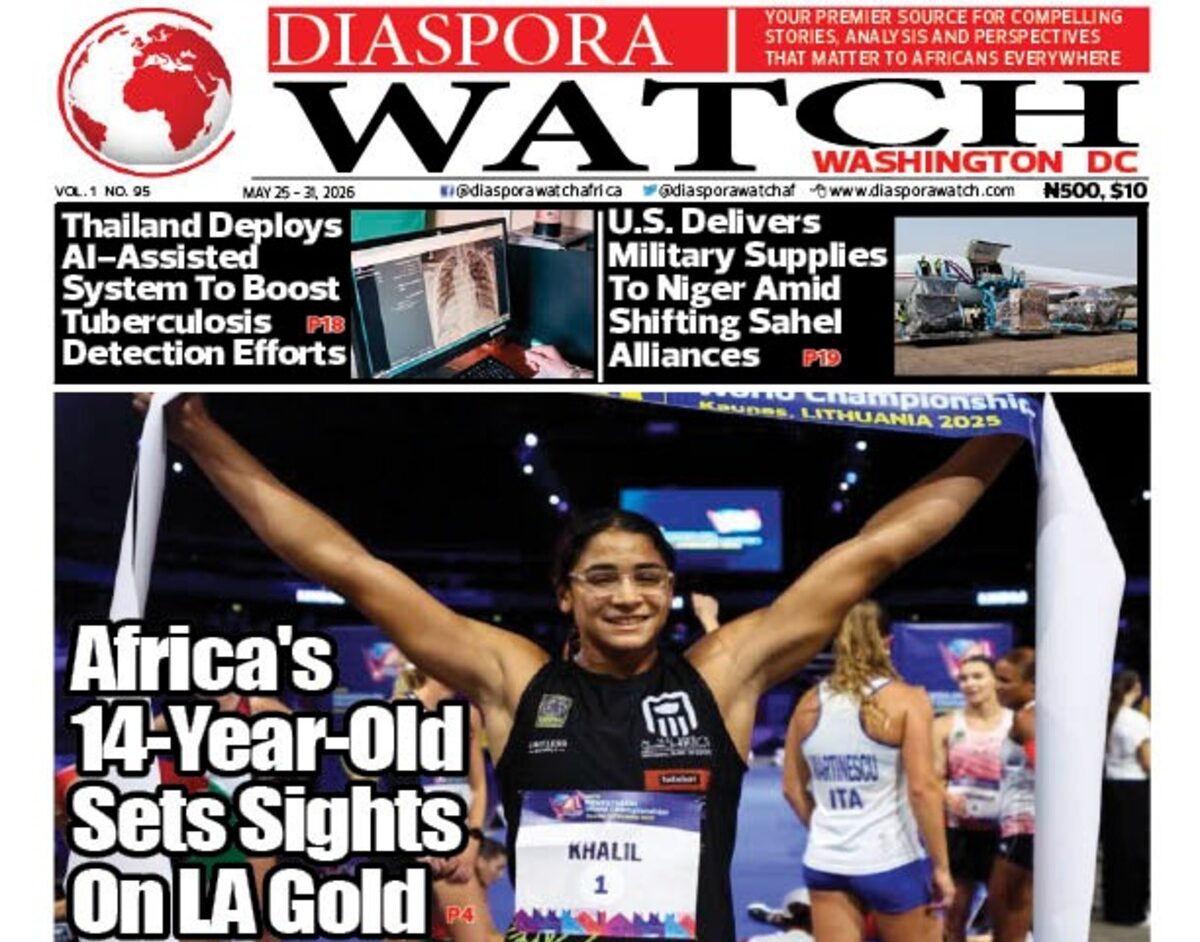
Diaspora Watch Newspaper is pleased to announce the publication of its 95th Edition, offering readers a compelling blend of international affairs, African development, diplomacy, health innovation, security, climate change, and human-interest stories shaping conversations across the globe.
Leading this week’s edition is the inspiring story of Egypt’s teenage sporting sensation, Farida Khalil, under the headline, “Africa’s 14-Year-Old Sets Sights on LA Gold.” The report chronicles the remarkable rise of the young athlete whose extraordinary achievements have positioned her as one of Africa’s brightest prospects ahead of the 2028 Los Angeles Olympic Games.
Diaspora Watch FREE Digital View: https://diasporawatch.com/3d-flip-book/diaspora-watch-vol-95/
On Demand Print: https://www.magcloud.com/browse/issue/3347818?__r=1069759
SUBSCRIBE TO DIASPORA WATCH NOW ON THE LINK BELOW!!!
https://diasporawatch.com/subscribe-to-diaspora-watch-newspaper/
Also making the front page is a major international legal development as a tribunal rules in favour of Britain in “Court Clears UK Over Scrapped Rwanda Migrant Pact,” ending a high-profile dispute over the controversial asylum relocation agreement.
The edition further examines unfolding political developments in the Horn of Africa through “Ethiopia Suspends Voting in Conflict-Hit Areas as Abiy Seeks Fresh Mandate,” highlighting the challenges facing Africa’s second-most populous nation amid security concerns and democratic transitions.
address environmental challenges confronting humanity.
In the area of health and technology, readers will find an insightful report on Thailand’s deployment of an AI-assisted system to improve tuberculosis detection, showcasing how innovation is transforming healthcare delivery and disease surveillance.
Security and geopolitical realignments in West Africa are explored in “U.S. Delivers Military Supplies to Niger Amid Shifting Sahel Alliances,” a report that sheds light on evolving international partnerships and strategic interests in a region grappling with persistent security threats.
The growing impact of climate change remains a central concern in this edition, with the United Nations warning of sustained global heat through 2030, reaffirming the urgency of collective action to
From the United States comes a politically charged story as President Donald Trump advances a proposal for a $250 bill bearing his portrait, triggering sharp reactions from political opponents and reigniting debate over leadership, legacy, and symbolism in American politics.
Diplomatic developments also take centre stage with coverage of efforts to deepen cooperation between the Caribbean and Europe in “CARICOM, Italy Strengthen Bilateral Ties as New Envoy Assumes Office.”
On the Back Page, readers will enjoy a lighter but culturally significant feature as New York City Mayor Zohran Mamdani attracts widespread attention with an Arsenal-inspired outfit worn during Eid celebrations, blending sports, identity, and public life in one memorable appearance.
As always, Diaspora Watch Newspaper remains committed to delivering credible journalism, insightful analysis, and stories that connect Africa, its diaspora, and the wider world.
The 95th Edition is now available to readers across our platforms.
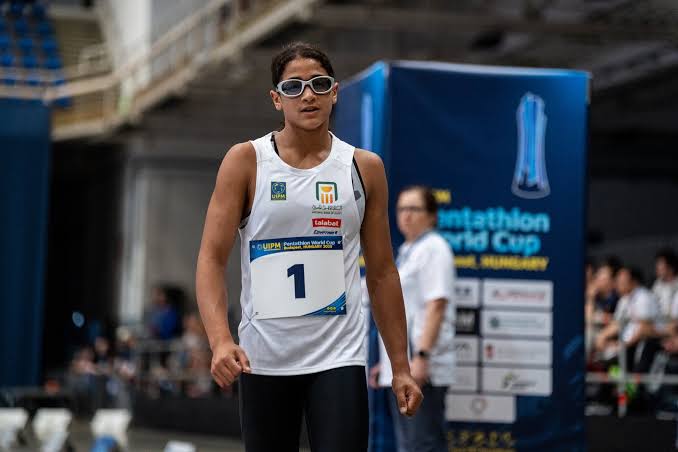
Africa’s 14-Year-Old Sets Sights on LA Gold
A 14-year-old Egyptian athlete, Farida Khalil, has captured global attention after emerging as one of the world’s most promising young obstacle-course competitors, with her family setting sights on a gold medal at the 2028 Los Angeles Olympics.
Khalil, who trains at El Shams Sporting Club in Egypt, has rapidly risen through the ranks of the sport since beginning competitive participation in youth championships in 2021, prompting comparisons with some of the world’s elite athletes despite her young age.
Dressed in a black Team Egypt T-shirt bearing a golden image of Horus, the ancient Egyptian sky god symbolising power and royalty, the teenager undergoes an intensive training regime under the supervision of her father and coach, Ahmed Abu Hashem.
At the club, Khalil navigates demanding obstacle courses, leaping from elevated platforms and manoeuvring across suspended metal ladders with remarkable agility and strength, skills that have helped establish her as a rising force on the international stage.
According to Abu Hashem, the teenager’s rigorous training schedule reflects the lofty ambitions surrounding her career.
“The schedule for Farida is very strong,” he said.
“We are building a big dream, so every minute has to count. This spirit is what makes Farida different from others all over the world.”
Abu Hashem disclosed that Khalil’s progression through the sport was so rapid that she quickly outgrew youth competitions and began competing against senior athletes.
He said the family became convinced of her exceptional potential after analysing her performances against global benchmarks.
“We found we were winning with very competitive scores,” he explained.
“I started calculating the world records and found that Farida can break them very easily.”
Khalil’s rise comes as Egypt continues to strengthen its profile in international sports, with the North African nation producing a growing number of athletes capable of challenging for honours on the world stage.
With the 2028 Olympic Games in Los Angeles now firmly in view, Khalil and her team believe she can convert her remarkable promise into Olympic success, a feat that would further cement her status as one of Africa’s brightest young sporting talents.
If successful, the Egyptian teenager could become one of the youngest African athletes to win Olympic gold, adding another chapter to her rapidly growing reputation as a world-class competitor in the making.


The Likes of Kila in Our Society, by Alabidun Shuaib AbdulRahman

CARICOM, Türkiye explore cooperation in trade, energy, food security

Britain restricts Eritrean diplomats, threatens entry ban

Pastor Jerry Eze Defends Miracles At UK Conference Amidst Criticism And Controversy

Diaspora Watch 20th Edition (October 14-20, 2024): Your Trusted Source for Global News and Insights

Tanzanian Man Reportedly Dies And Returns To Life Six Times


-

 Analysis6 days ago
France in Crisis: Anger and Unrest Shake the Nation
-
 Diplomacy6 days ago
CARICOM, Türkiye explore cooperation in trade, energy, food security
-
 News6 days ago
Britain restricts Eritrean diplomats, threatens entry ban
-

 Business6 days ago
Africa Loses $75bn Yearly to Risk Premiums, Experts Warn
-

 News6 days ago
Zelenskyy seeks European support as Trump tensions deepen
-

 Opinion6 days ago
Before You Collect That Peanut, Remember Your Future, by Boniface Ihiasota